Lynwood Wood Flooring installs and restores wood flooring in Bell Gardens, and a large share of that work involves matching new material into something considerably older. Getting that right is a specific skill, and it fails far more often on width and profile than on species, which is the thing most people assume matters most.
Bell Gardens holds the oldest building in Los Angeles County, and while that particular structure is not representative of the housing stock, it points at something real about the area: this is not uniform post-war tract building. There is genuinely old fabric here, and older buildings carry flooring details that current stock simply does not — different board widths, different milling, different relationships between floor and trim.
Matching into that fabric means treating the existing house as the specification rather than picking from a supplier’s current range and hoping. Sometimes the right material is not the closest modern equivalent but something ordered specifically, and knowing when that is worth doing is most of the job.
Matching a Floor to Its Period
Width Is What the Eye Reads First
Before species, before color, before grade, the eye registers how wide the boards are. A modern three-inch plank set beside original two-and-a-quarter strip will read as two different floors no matter how carefully everything else is matched, because the change in line spacing is visible from across the room. Width matching is the single highest-value decision in this kind of work.
The reason is that the eye reads spacing before it reads anything else about a surface. A floor presents as a field of parallel lines at a particular frequency, and a change in that frequency registers immediately even to someone who could not say what they were noticing. Color differences get attributed to light or wear; a change in line spacing gets attributed to a repair.
It is also the one that cannot be corrected afterwards. Color can be brought together at the finish stage by sanding and staining everything as one surface. Grade differences soften once a floor is finished and furnished. Width is fixed in the material, so if it is wrong at the order stage it is wrong permanently, and the only remedy is taking the new floor back up.
Profile and How Boards Meet
Older flooring frequently has a different edge profile from current stock — square edges rather than the slight bevel most prefinished product carries, and sometimes a different tongue and groove geometry entirely. A square-edged original floor beside micro-bevelled new boards shows a line of small shadows exactly where the two meet, which reads as a seam even when the color is perfect.
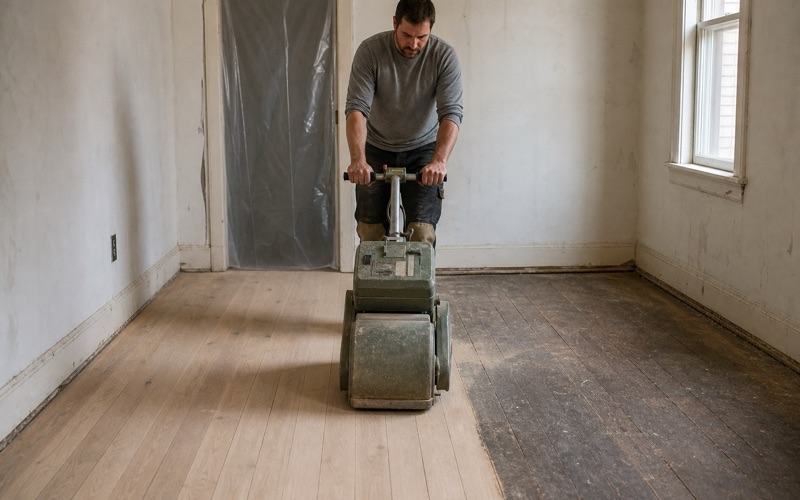
Where the existing floor is square-edged, unfinished material sanded flat after installation is nearly always the better route than prefinished. Site finishing removes the edge distinction entirely, because the new boards get cut back to the same plane as the old ones and take the same coating across the joint. A prefinished board carries its factory bevel permanently and there is no way to remove it afterwards.
Thickness and Sitting Flush
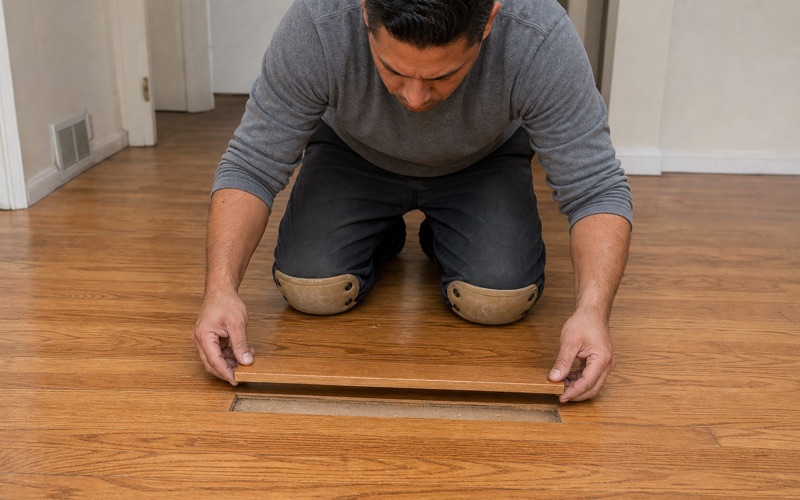
Older solid flooring is not always the thickness modern material is milled to, and a difference of a millimeter or two is enough to be felt underfoot and seen in raking light. Where thicknesses differ the subfloor gets packed or planed locally so the finished surfaces sit flush, which is slow work and is the difference between a repair that disappears and one that catches the eye and the foot.
Looking for wood flooring closer to Florence-Graham? See Wood Flooring in Florence-Graham.
Width, Grade and Species
Identifying What Is Actually There
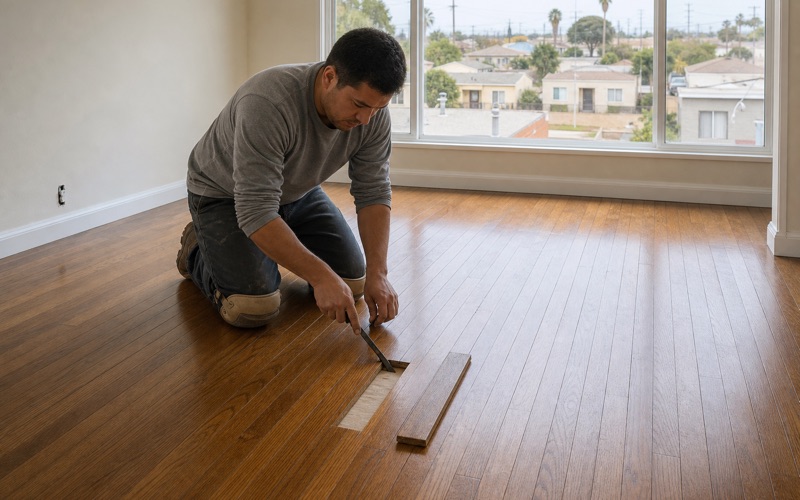
Before matching anything we establish what the existing floor is, which is not always obvious under a century of finish. Species is read from grain and pore structure on a sanded test patch rather than guessed from color, since stain and age move color a long way from where the timber started. Red oak and white oak in particular are frequently confused, and they take stain quite differently.
That distinction has real consequences once color is chosen. Red oak carries a pink undertone that reads through lighter stains and cannot be removed by sanding, since it belongs to the timber rather than to any coating. Matching new white oak into an existing red oak floor produces two subtly different colors under the same stain, and the difference only becomes visible after the finish goes on.
Choosing a Grade That Belongs
Mill grades sort by appearance — select grades give even color with minimal knots, while character and rustic grades keep the variation. Older floors are very often character grade by modern standards simply because that is what was ordinary at the time. Setting a clean select board into a floor full of mineral streak and knots looks like a repair, which is exactly what matching is trying to avoid.
When to Order Specifically
Sometimes the closest thing on a supplier’s shelf is not close enough, and the honest answer is to order material milled to the original width or to source reclaimed stock of the right period. That costs more and takes longer, and it is not always warranted. We are straightforward about when a standard product will genuinely disappear into the floor and when it will not, so the decision is yours with the trade-off visible.
Reclaimed stock is the other route worth considering where the match has to be close, and it carries its own requirements. Old boards need metering on arrival because their moisture content is unknown, and they need checking for embedded fasteners before they go anywhere near a saw or a sander. Both are straightforward, and neither is optional.
Finishes That Suit Older Fabric
Sheen and Age
High gloss on an older floor tends to look wrong, and it is worth understanding why rather than treating it as taste. Gloss reflects light evenly, which draws attention to any unevenness in a floor that has settled and moved over decades. Matte and satin finishes absorb that variation, hide traffic lanes and scratches far better, and sit more comfortably against older trim and plaster.
Color Against Existing Woodwork
An older house usually has other wood in the room — baseboards, casings, sometimes built-ins — with its own color and its own age. A floor finished without reference to those reads as a new element dropped into an old room. We put test patches down and look at them against the existing woodwork in the room’s own light rather than deciding from a sample card elsewhere.
What Can Legally Be Applied Here
Whatever finish is specified has to be a product legally sold and applied in this air basin, where wood coatings are capped at 275 grams per liter of VOC. That is a real local constraint and it makes the available shelf genuinely shorter than in most states, pushing most work toward waterborne two-component finishes and hardwax oils. Both suit older floors well, so the constraint costs little here.
Hardwax oils in particular tend to suit older timber, because they sit in the wood rather than forming a thick film across the top of it. That leaves more of the grain and texture visible and gives a lower sheen without looking coated, which is generally what an older floor wants. They are also repairable in patches, which a film finish is not.
Where New Work Meets Old
Lacing Rather Than Butting
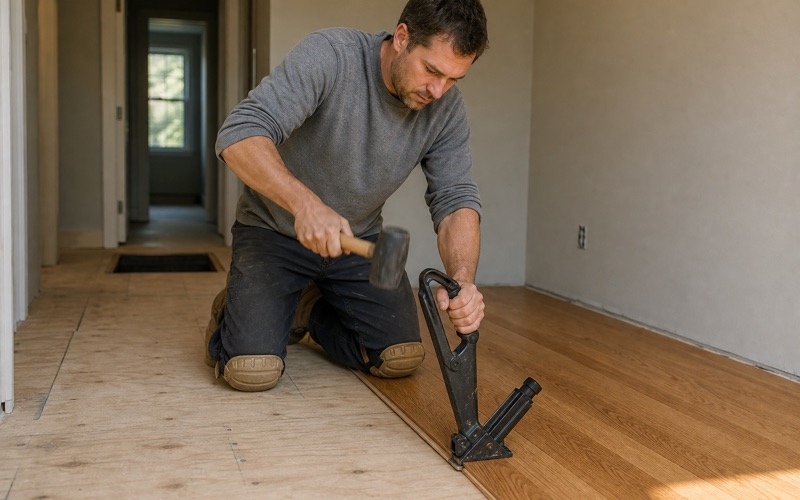
New boards are laced into the existing layout with end joints staggered into the surrounding pattern, never butted in as a block or a straight row. A continuous seam across an opening announces the repair permanently, whereas a staggered transition disappears entirely once the floor is sanded and finished as one surface. This is the technique that separates a repair from a patch.
Sanding the Whole Area Together
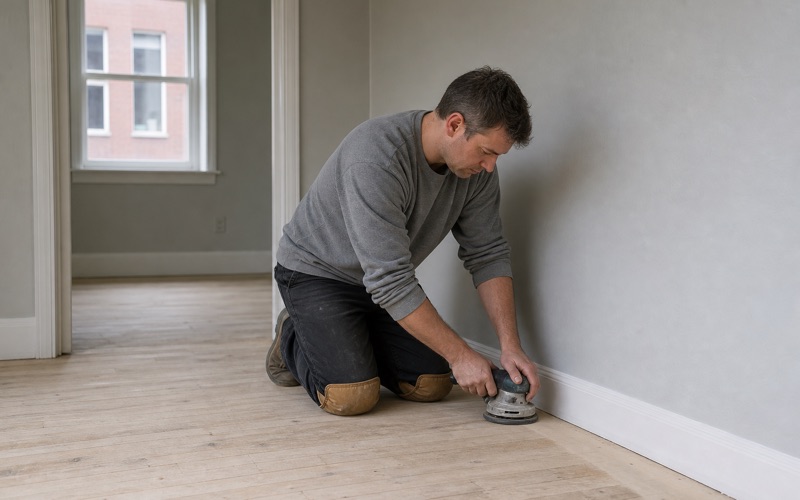
Color matching happens at the finish stage rather than at the timber yard, which is why we would nearly always rather lace in unfinished material and sand everything together than chase a prefinished board that looks close in a showroom. Both old and new take the same stain and the same coats on the same day, which is the only reliable way to make them read as one floor.
Additions and Changes of Era
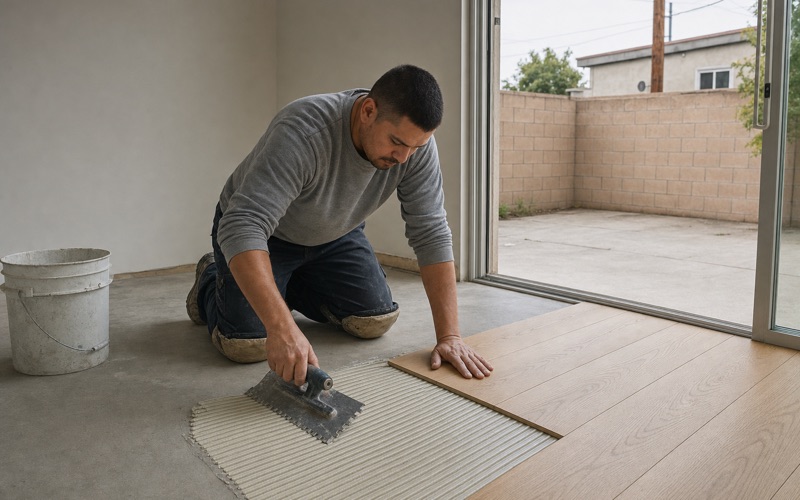
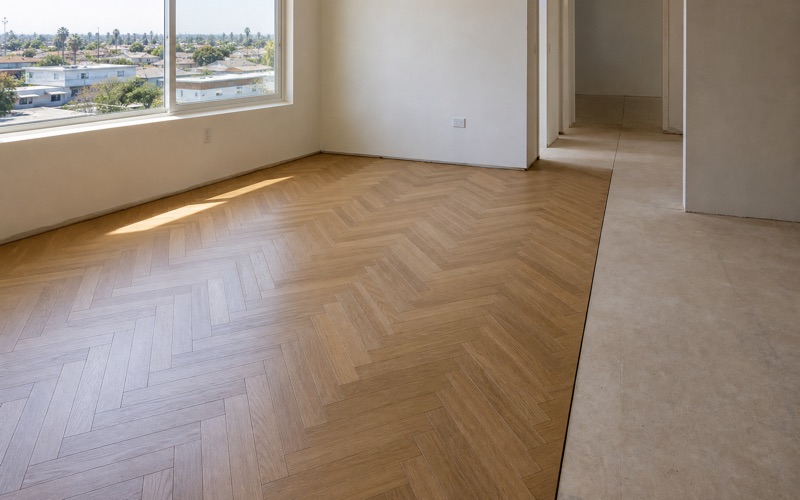
Houses of this age have frequently gained rooms, and the addition rarely has matching flooring or even a matching substrate — an original raised section with a later slab-built room off the back is common. Where the two are at compatible heights they can often be made continuous. Where they cannot, the transition is detailed deliberately rather than covered with a strip dropped in to hide the change.
Where heights genuinely differ, a properly profiled reducer sloping from one level to the other reads as a considered detail. Where they are close, packing the lower subfloor to bring the two into plane is usually achievable and is worth the effort, because a continuous floor through an opening does more for how a house feels than almost any other decision at this stage of the work.
- 20+ Years in Southeast LA
- Free Written Estimates
- Licensed & Insured