
Lynwood Wood Flooring has been sanding and refinishing hardwood floors in Lynwood, CA for more than twenty years, serving surrounding cities including South Gate, East Rancho Dominguez, Willowbrook, Compton and Paramount. Refinishing is the largest part of what we do, because most of the housing in this part of Los Angeles County already has wood under it — sometimes under carpet the owner has never lifted.
The first thing worth knowing is that a worn floor and a finished floor are different problems. A floor whose coating has dulled needs the coating renewed. A floor worn through to bare wood needs the wood itself taken back and rebuilt. Those two jobs differ by several times in cost, and the cheaper one is right more often than most people are told.
So we start by measuring rather than quoting. We look at how much wood is left above the tongue, whether the finish is breached or merely tired, and what the boards are actually made of. If your floor does not have enough depth left to survive a full sand, we will tell you that at the estimate — sanding it anyway turns a repairable floor into a replacement.
Refinish or Recoat: The Question That Sets the Price
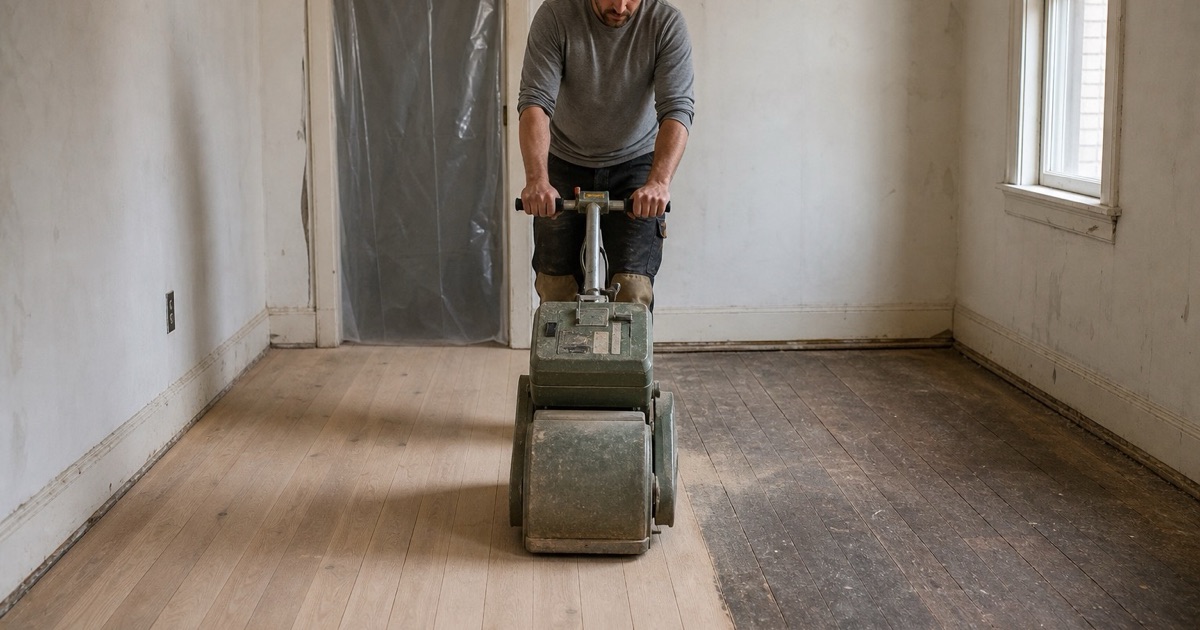
Full Sand and Refinish
A full refinish takes the floor back to bare wood through a sequence of progressively finer abrasives, then rebuilds the finish from nothing. It is the only route that removes deep scratches, pet stains that have reached the grain, and any existing stain color. It is also the only route that spends wood, which is why we treat it as the answer of last resort rather than the default recommendation.
Screen and Recoat
A screen and recoat abrades only the existing finish, keys it so a new coat will bond, and adds fresh coating over the top. No wood is removed at all. It costs a fraction of refinishing, takes far less time, and leaves the floor’s remaining life untouched. The catch is that it works only while the finish layer is still continuous — once bare wood is showing in a traffic lane, recoating locks that damage under a new surface.
Measuring What Is Left
The decision between the two is not a judgment call if you take a measurement. We find an exposed board edge, usually at a floor vent or a threshold, and read how much sandable wood sits above the tongue. On engineered boards the same reading tells us the wear layer thickness, and some engineered products are simply too thin to sand at all. That number, not the floor’s appearance, decides what we recommend.
What Sanding Actually Takes Off
The Grit Sequence
Sanding is a sequence, not a single pass. A typical full refinish starts around a 36 grit cut to level the floor and remove the old finish, then steps through 50 and 80 to erase the scratch pattern the previous grit left behind. Skipping a step is how a floor ends up with visible sanding marks that only appear once the finish goes on and the light catches them.
Where the Machines Cannot Reach
A drum or belt machine handles the open field, but it cannot get within a few inches of a wall, and it cannot enter a closet or a corner. Those areas are cut with an edger and blended by hand so the transition does not show as a darker band around the room perimeter. Edge work is slow, it is where most of the skill sits, and it is the first thing a rushed job gives up.
Containment and Dust
Our machines run into an extraction and containment system, and we seal the rooms that are not being worked before anything starts. Fine dust still travels, so we would rather set expectations honestly than sell the word dustless as though it meant zero. On pre-1978 houses, which is most of the stock here, containment is not a convenience — it is how the job is done safely.
Color, Stain and Sheen
Changing a Floor’s Color
Once a floor is down to bare wood most colors are available, but the species sets the limits. Red oak’s pink undertone reads through lighter stains, white oak takes a cooler range, and no stain lightens wood beyond its own base tone. We put sample patches on your actual floor and look at them in your own light, because a stain that looked right in another house frequently does not.
Taking a Dark Floor Lighter
Dark stained floors went into a great many houses here over the last two decades, and a lot of owners now want them back toward natural. That is always a full sand, because stain lives in the wood rather than on it. How light the floor can go depends entirely on what species is under the color, which is something we can only confirm by cutting a test area first.
Choosing a Sheen
Sheen is measured as a gloss level, but you choose it by how the room reads. Higher gloss bounces more light and shows every scratch, footprint and dust mote. Matte and satin hide wear and traffic lanes far better, which is why they now dominate. In a room with large windows the sheen choice is usually the difference between a floor that looks calm and one that looks streaked all afternoon.
Our Step-by-Step Hardwood Floor Refinishing Process
Assessment and Wear-Layer Reading
We start at an exposed board edge and establish how much sandable wood remains, then check the worn areas, the room edges and any water staining. This is where the refinish-or-recoat decision gets made, and it is made on a measurement you can see rather than on our opinion of how the floor looks.
Written Scope and Finish Selection
You get a written scope separating material, labor and the add-ons — furniture moving, containment, board replacement, stairs. Finish selection happens here too, from products that can lawfully be sold and applied in this air district, where wood coatings are capped at 275 grams per liter of VOC. That limit is real and local, and it makes the finish shelf here genuinely shorter than in most states.
Preparation and Containment
Furniture comes out, the room gets sealed, and any protruding fasteners are set below the surface so they do not tear an abrasive belt. Loose or damaged boards are replaced at this stage rather than sanded around, because a board that needs replacing after finishing means finishing that area twice.
Sanding and Edge Work
The field is cut through the grit sequence, the perimeter is edged, and corners are finished by hand. Between passes we look at the floor under raking light, which shows scratch patterns that are invisible under normal room lighting and completely obvious once a coating goes over them.
Coating and Cure
Stain goes down first if the floor is being colored, then the coats, with abrasion between them where the product calls for it. We tell you the cure schedule for the specific finish in advance — when it takes foot traffic, when rugs can go down, and when furniture can return. Most avoidable damage to a new floor happens in that window, from furniture arriving before the finish has hardened.
- 20+ Years in Southeast LA
- Free Written Estimates
- Licensed & Insured