
Lynwood Wood Flooring repairs hardwood floors across Lynwood, CA and the cities around it, including South Gate, East Rancho Dominguez, Willowbrook, Compton and Paramount. Most of what we repair is not dramatic — it is a squeaking hallway, a split board by the kitchen door, a strip of bare subfloor where a wall used to be, or a patch worn through by twenty years of the same route across a room.
The useful thing to know about hardwood is that it is almost always repairable. Very few flooring problems genuinely require a new floor, and a great many quotes recommend one anyway because replacement is simpler to price than repair. A floor with sandable depth left and a sound subfloor beneath it can absorb a remarkable amount of localised damage and come back looking untouched.
What makes a repair invisible is not the carpentry on the damaged boards themselves — it is how the new work is joined into the old. Boards laced into the existing pattern with staggered joints, then sanded and finished as one continuous surface, disappear. The same boards fitted as a neat rectangle will read as a patch for the life of the floor.
Squeaks and Movement
What a Squeak Actually Is
Wood does not squeak; movement does. The sound is either a board shifting against the fastener holding it, or a subfloor panel lifting a fraction off a joist and dropping back as weight passes over it. Identifying which of the two you have is the whole job, because they are fixed from opposite directions and the wrong fix simply relocates the noise a few feet away.
Fixing It From Below
Where a crawl space or an open ceiling gives access underneath, the durable repair is made from there — shimming the gap between subfloor and joist, or drawing the two back together. Nothing touches your finished floor at all, so there is no patching, no refinishing and no color matching. In this housing stock, where raised floors are common on the older streets, this is frequently available.
Fixing It From Above
Without access from beneath, the fix is made through the floor and concealed. Fasteners are driven at an angle through the board into the joist below, set beneath the surface and filled to match. It is entirely effective and it is the standard approach on a slab-built house, where there is no underside to work from and every repair has to come from the room side.
Damaged and Missing Boards
Replacing Individual Boards
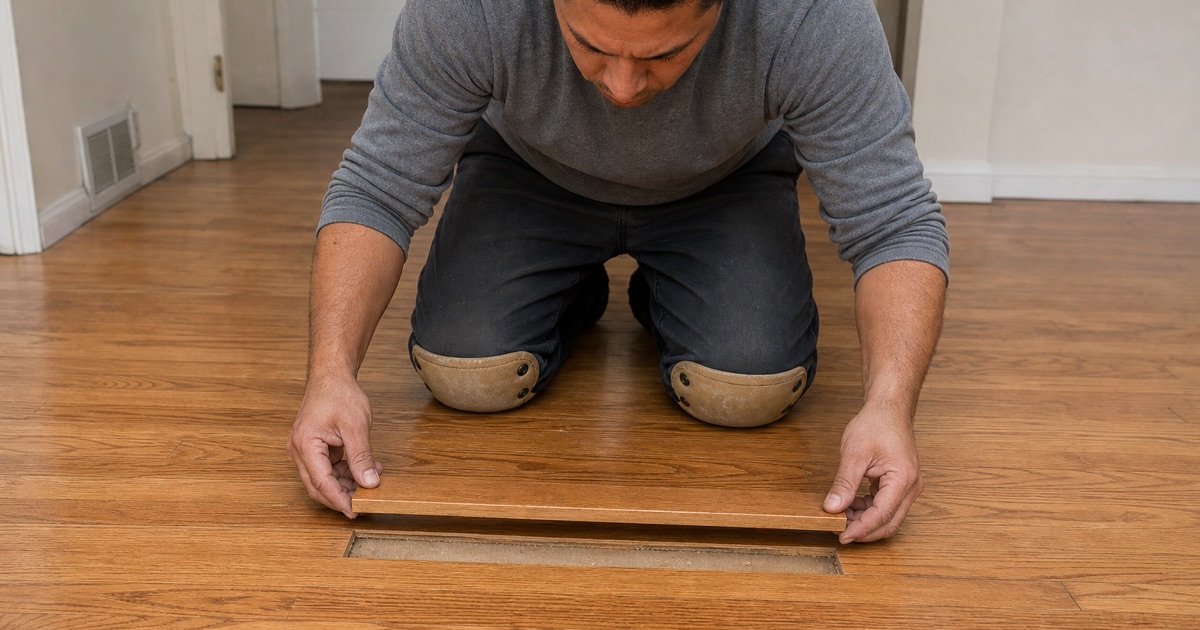
A damaged board is cut free and lifted without disturbing its neighbours, and a new one is fitted into the gap. The skill sits in the joinery rather than the removal — the replacement has to sit at exactly the height of the boards around it, because a board a fraction proud or low will show through any finish and catch underfoot for the life of the floor.
Dutchman Patches
Where the damage sits inside a board rather than across it — a burn, a deep gouge, an old fixing hole — the whole board does not need to go. A section is cut out and a matching piece of the same species let in, following the grain direction so the repair reads as part of the board. It is a traditional joinery repair and it is invisible once the floor is sanded.
Lacing In After a Remodel
Removing a wall leaves a strip of missing floor where the plate sat, and this is one of the most frequent repairs we are called for. The correct fix is not to fill the strip with a neat row of boards, which draws a permanent line exactly where the wall stood. New boards are laced into both sides so the end joints stagger into the existing pattern, and the whole area is refinished together.
Surface Damage
Scratches and Worn Traffic Lanes
Most scratching lives in the finish rather than the wood, which is good news — a screen and recoat restores the entire floor without spending any timber. Worn lanes down a hallway or around a kitchen island are the same story until the wear breaks through to bare wood. We check whether the damage has reached the timber, because that single fact separates a cheap job from an expensive one.
Dents and Compression
A dent is compressed wood fibre rather than removed material, which is why some shallow dents in unfinished wood can be raised with moisture and heat before any sanding is considered. Deeper compression, and anything that has broken the surface, needs sanding out or replacing. The choice depends on how much sandable depth the floor has left, which we measure rather than estimate.
Pet Stains
A stain sitting on the finish comes away with the finish. One that has soaked through into the grain is in the wood itself, and a black urine stain that has reached the subfloor will not sand out at any depth a floor can afford to lose. Those areas need the boards replaced and laced in. We are honest about which stains will lift and which will not.
When the Floor Sounds or Looks Wrong
Hollow Boards and What They Can Mean
A board that sounds hollow underfoot may just have lost its bond to the subfloor beneath it. It can also mean the timber has been eaten from the inside, which here is a genuine possibility worth ruling out rather than an exotic one. We open the area instead of filling over it, and if the cause turns out to be pest damage that gets addressed before any flooring work begins.
Gaps That Come and Go
Solid wood shrinks in dry months and swells in humid ones, so narrow gaps that open in one season and close in the next are the floor behaving exactly as it should, and filling them causes damage when the wood expands again. Gaps that stay open all year, or appear in only one part of a room, are a different matter and point to a moisture problem or a failed installation.
- 20+ Years in Southeast LA
- Free Written Estimates
- Licensed & Insured