
Lynwood Wood Flooring installs herringbone wood floors and other pattern work throughout Lynwood, CA, serving surrounding cities including South Gate, East Rancho Dominguez, Willowbrook, Compton and Paramount. Pattern flooring, wide plank and parquet are the part of this trade where the layout matters as much as the material, and they are what almost nobody in this market is offering.
The common thread across everything on this page is planning. A straight-laid floor can be started at a wall and worked across a room. A pattern floor cannot — it is set out from a centerline established before a single board is fixed, because a pattern that drifts by a fraction at one end of a room is glaringly obvious at the other.
The second thread is flatness. Any unevenness in a subfloor shows up in pattern work several times more readily than under straight boards, because the eye has strong repeating lines to compare against. Preparation that would be adequate for plank flooring is often not adequate here, and that is worth knowing before the material arrives.
Herringbone and Chevron
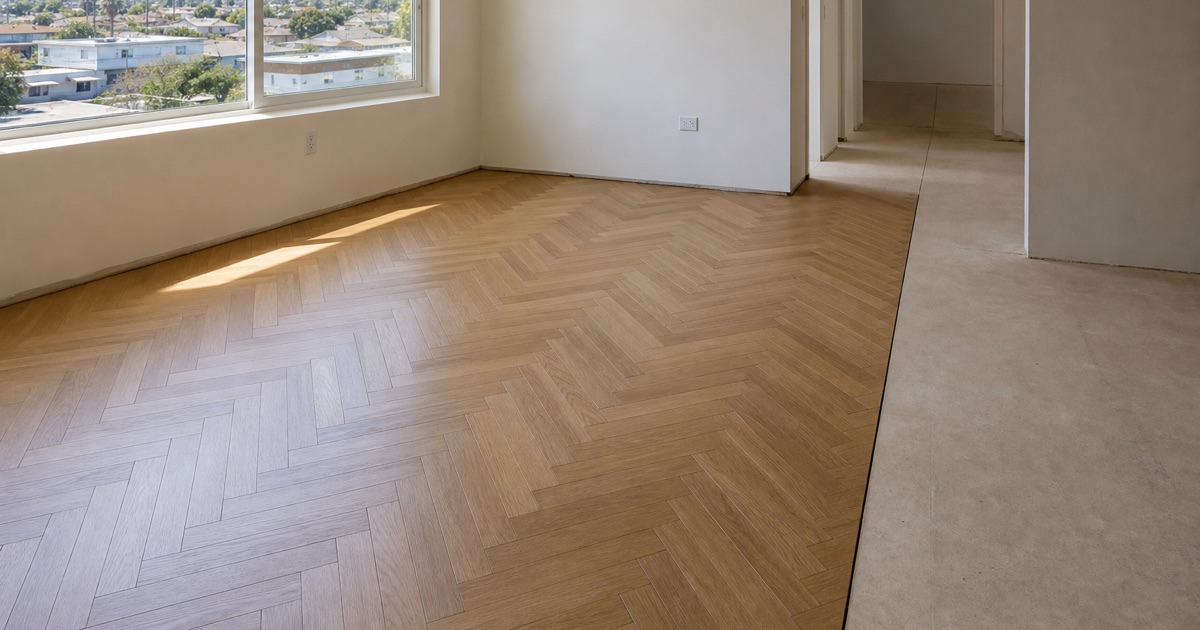
Herringbone
Herringbone lays rectangular boards with square-cut ends at right angles to one another, each stepping off its neighbour so the pattern reads as a staggered zigzag. It is the older and more forgiving of the two patterns, it suits both traditional and contemporary rooms, and the square cuts mean the boards themselves are standard stock. The precision lives entirely in the setting out.
Chevron
Chevron mitres both ends of every board so that adjacent boards meet point to point, producing continuous unbroken Vs running down the room. The effect is sharper and more directional than herringbone, and it draws the eye along its axis, which can be used to lengthen a room visually. Every board is angle-cut, so both the material cost and the labour are higher.
Choosing Between Them
Herringbone reads as texture and works in almost any room, including smaller ones, because the pattern breaks the floor into a fine repeating grid. Chevron reads as direction and wants a run long enough to develop. In a compact room chevron can feel insistent while herringbone settles down. We lay out both on the actual floor plan before you commit to either.
Parquet and Panels
Parquet Blocks
Parquet is wood laid in geometric blocks rather than continuous boards, usually assembled into squares of short strips set alternately. It was standard in a great many houses of this era and it is often still there under carpet or vinyl. As a new floor it gives a fine-grained, formal surface that suits entries and dining rooms particularly well.
Versailles and Panel Patterns
Versailles panels are the most elaborate form of parquet — large square panels with an interlaced diagonal lattice inside a border frame. They are made up as panels and set as units, and they demand a genuinely flat substrate and a carefully planned layout, because the panel grid has to relate sensibly to the room’s own walls and openings.
Restoring Parquet That Is Already There
A great deal of the parquet we work on has been under carpet for thirty years and is in better shape than anyone expected. Sanding it is a different discipline from sanding plank flooring, because the grain runs in several directions within a single square and a machine driven in one direction will tear one set of blocks while cutting the other cleanly. Lifted or missing blocks are replaced individually first.
Wide Plank
What Width Changes
Wide boards mean fewer seams, and fewer lines across a floor generally makes a room read calmer. They also show more of each board’s figure and character, which is the point — a wide plank floor is showing you the timber rather than a repeating rhythm of joints. In post-war houses with modest room sizes this reads as generous rather than out of scale.
The Moisture Caution
A wider board expands and contracts more across its face than a narrow one, because there is simply more width to move. That raises the standard for everything upstream: acclimation in the room, moisture readings that agree between wood and subfloor, and on concrete a slab reading properly before anything is bonded. Wide plank is not harder to install so much as less forgiving of skipped preparation.
Character and Surface Texture
Wide boards are usually chosen alongside a surface treatment, and the vocabulary is worth knowing. Wire-brushing scours the softer grain to leave an open texture; hand-scraping gives a rolling, undulating surface; distressing adds deliberate marks. All three hide everyday scratching far better than a smooth floor, which is why they suit busy households.
Borders and Detail
Borders and Inlays
A border runs boards perpendicular around a room’s perimeter, framing the field inside it and giving the floor a deliberate edge rather than a cut line at the skirting. An inlay sets a contrasting species or pattern into the field itself. Both are traditional work, both are largely absent from this market, and both are far more affordable than people assume when confined to one room.
Where Patterns Meet Everything Else
A pattern floor has to resolve where it meets a doorway, a tiled area or a staircase, and those junctions are where pattern work succeeds or fails. A border is frequently the answer, giving the pattern a clean frame to die into instead of running raggedly to a threshold. We plan those transitions at layout stage, not when the pattern arrives at them.
- 20+ Years in Southeast LA
- Free Written Estimates
- Licensed & Insured