
Lynwood Wood Flooring handles water damaged hardwood floor repair throughout Lynwood, CA, serving surrounding cities including South Gate, East Rancho Dominguez, Willowbrook, Compton and Paramount. Twenty years of this work in the same housing stock means we have seen the same failures repeatedly — the dishwasher supply line, the water heater in the hall closet, the upstairs unit’s angle stop — and we know what each one does to a floor.
Water damage is the one flooring job where the carpentry is often the smaller half. What the floor needs is usually straightforward. What decides the outcome is whether the damage was assessed properly, whether the wood was allowed to dry before anyone made a decision, and whether the claim was documented in the terms an adjuster actually works in.
We do all three. We meter rather than guess, we let the floor tell us what it can recover from, and we produce a written scope that maps onto how the claim will be evaluated. If the floor can be saved we will say so, and if it genuinely cannot, the documentation supporting that is already in your hands.
Assessing a Water Damaged Wood Floor
What Water Actually Does to Wood
Wood takes on moisture from whichever face is wet, and it swells unevenly as a result. Water reaching the underside makes board edges rise above their centers, which is cupping. Water arriving from above, or a cupped floor sanded before it dried, produces the reverse. Boards that swell hard against each other with nowhere to expand can lift clear of the subfloor entirely, and that is buckling.
Metering, Not Looking
A floor that feels dry underfoot can still be holding a great deal of water, and the surface is the last part to release it. We take readings in the damaged boards, in the sound boards around them, and in the subfloor, using meters set to the species rather than a default. The comparison is what matters — damaged wood measured against undamaged wood in the same house on the same day.
Finding the Boundary
Water travels further than the stain suggests, following the subfloor and wicking along board seams into rooms that look untouched. Establishing the true edge of the affected area matters for the repair and matters again for the claim, because the boundary is what the scope is built from. We map it with the meter rather than by eye, and we record where it runs.
Repair or Replace
Drying First, Deciding Second
The most expensive mistake in this work is deciding too early. A cupped floor that has been dried properly frequently flattens out and needs nothing more than sanding, while the same floor condemned in week one becomes a full replacement. We dry, we track readings until they stabilize, and we reassess against the numbers rather than against the first impression.
Replacing Boards and Lacing Them In
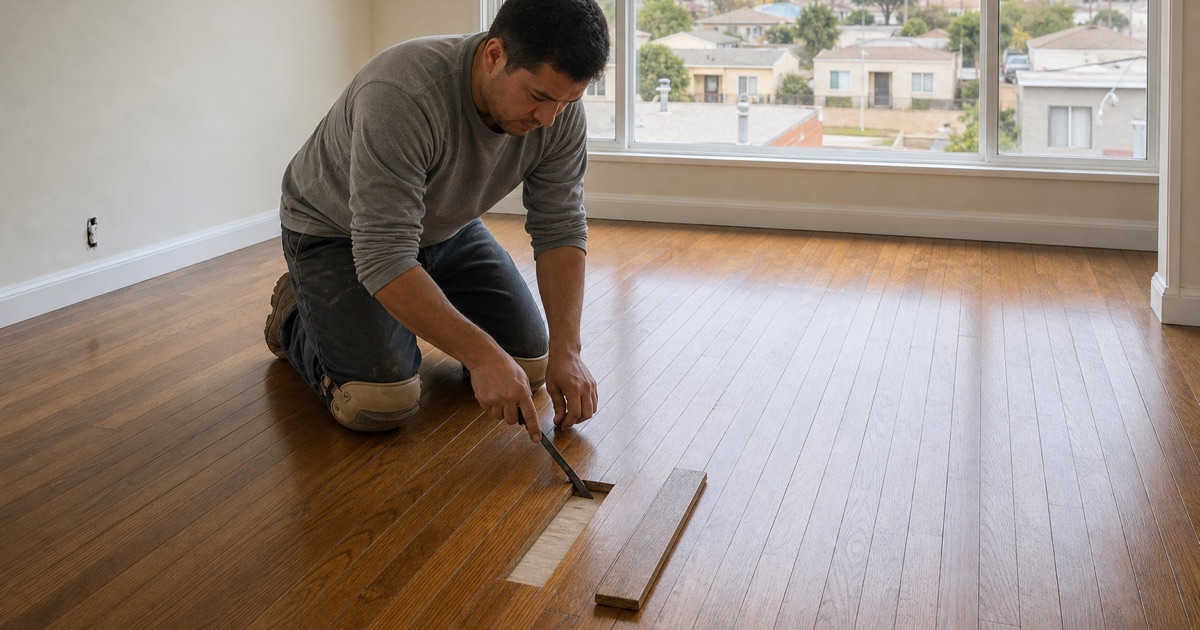
Where boards are genuinely gone — split, delaminated, or stained through to the subfloor — they come out individually and new ones go in. The joints are staggered into the surrounding layout rather than cut as a straight line across the room, so once the floor is sanded and finished as a single surface the repair is not findable. A localized defect inside one board can often be cut out and patched instead.
When Replacement Is the Honest Answer
Some floors do not come back. Engineered boards that have delaminated cannot be re-bonded, wood that has been wet long enough to soften or grow is not salvageable, and a floor with no sandable depth left cannot absorb the refinishing that a repair requires. When that is the situation we say so plainly and document why, because that reasoning is exactly what a claim needs.
Working With Your Insurance Claim
Sudden and Accidental Versus the Slow Leak
How the water arrived usually decides who pays. A supply line that fails without warning is treated very differently from a leak that has been quietly running behind a cabinet for a year, and outside flooding falls outside a standard policy altogether. We document what we find and where the moisture pattern points, and the carrier makes the coverage decision on that record.
Continuous Floor Area
This is the detail that moves the most money and the one homeowners hear on a claim call without anyone explaining it. A continuous area is floor visible from a single vantage point with no doorway, wall or threshold breaking it. California’s claims regulations require a damaged area to be restored to a reasonably uniform appearance, so whether your open-plan living and dining space is one area or two is a consequential question. We record where the breaks genuinely fall.
Recoverable Depreciation
Most policies pay actual cash value up front and hold back a depreciation amount that becomes claimable once the work is completed. A great many homeowners never claim it, simply because nobody told them it existed. We build the scope so the completed work maps cleanly onto the original estimate, which is what makes claiming that balance straightforward rather than a second argument.
Labor and Depreciation
It is worth knowing that California’s regulations do not allow labor to be depreciated in the same way materials are. On a hardwood repair — where sanding, edge work, board replacement and finishing are overwhelmingly labor — that distinction covers most of the invoice. We separate labor from material in every scope we write, which makes the point visible rather than buried.
Our Step-by-Step Water Damage Repair Process
Same-Week Assessment and Moisture Mapping
We get out quickly, because wood left wet keeps getting worse and the window for saving a floor closes. The first visit establishes the source if it is still live, maps the affected area with a meter, and produces a written record with the readings and the boundaries on it.
Drying and Monitoring
The floor is dried and then monitored, with readings taken over successive days until they stop falling and settle near the undamaged parts of the house. This is the stage that decides how much floor survives, and it cannot be compressed without costing you more floor than it saves in time.
Scope, Documentation and the Adjuster
You get a written scope separating labor, material and add-ons, with the continuous floor area identified and the moisture record attached. It is written so your adjuster is reading the same document you are, which removes most of the friction that turns a claim into a negotiation.
Repair, Refinish and Final Readings
Boards are replaced and laced in, the subfloor is repaired where it needs it, and the floor is sanded and finished as one surface. We take final moisture readings before the first coat goes on, because finishing over wood that has not fully stabilized traps the problem underneath a new surface where nobody will see it until it moves.
- 20+ Years in Southeast LA
- Free Written Estimates
- Licensed & Insured