
Lynwood Wood Flooring installs engineered hardwood flooring throughout Lynwood, CA, serving surrounding cities including South Gate, East Rancho Dominguez, Willowbrook, Compton and Paramount. A great deal of the housing in this area sits on concrete, and on concrete this is the floor that works — not a compromise, but the product the substrate calls for.
Engineered hardwood gets talked about badly. It is regularly presented as the budget alternative to real wood, which misdescribes what it is: the surface is solid sawn hardwood, identical in species and grain to a solid board. The difference is structural, and the structure is precisely what lets it live over a slab.
Everything on this page follows from one measurement. Before any engineered floor is specified for a concrete substrate, we test that slab for moisture with an in-situ relative humidity probe and write the number down. That reading decides the adhesive, the underlayment, the installation method, and occasionally whether the job can proceed at all.
What Engineered Hardwood Actually Is
The Construction
An engineered board is a wear layer of real sawn hardwood bonded over a core built from cross-laid plywood or high-density fibreboard. Because the core layers run in opposing directions, the board resists the seasonal expansion and contraction that moves a solid plank across its width. That stability is the entire point, and it is why the same species behaves differently in the two formats.
The Wear Layer
The wear layer is the only part that can ever be sanded, so its thickness sets the floor’s whole future. A generous layer tolerates a full refinishing sequence and sometimes more than one. A thin one is a single-life floor, to be recoated but never sanded. This number is the most important specification on any engineered product and it is the one showroom conversations skip most often.
How It Differs From Laminate and Vinyl Plank
Laminate is a photographic image under a wear coat, and luxury vinyl plank is polymer through and through. Neither contains wood you can sand, refinish or recolor, because neither contains wood at the surface at all. Engineered hardwood does. That distinction is worth being clear about, because all three get shelved together and sold on appearance.
Why It Is the Right Floor Over Concrete
What a Slab Does to Solid Wood
Concrete moves water vapor upward continuously, even when it is decades old and perfectly dry to the touch. A solid board absorbs that from beneath, swells on its underside, and cups. It also has nothing to fasten to, since a nail or cleat needs joists and a slab has none. Glue alone across a wide solid plank cannot hold against that seasonal movement.
Testing the Slab
We use an in-situ relative humidity probe following the ASTM F2170 method, which reads moisture from inside the slab rather than at its surface — surface tests can read dry while the body of the slab is not. Wood goes down over a slab reading at or under 75 percent RH. Above that, a mitigation membrane comes first, and finding that out before delivery is the difference between a delay and a failure.
Why It Varies Street by Street Here
This is not a question that can be answered regionally. Housing age differs sharply across short distances in this part of the county, and slab construction arrived with the post-war build-out, so the older streets frequently have crawl spaces where a neighborhood a mile away does not. We establish it on site every time rather than assuming a slab because of the zip code.
How It Gets Installed
Glue-Down
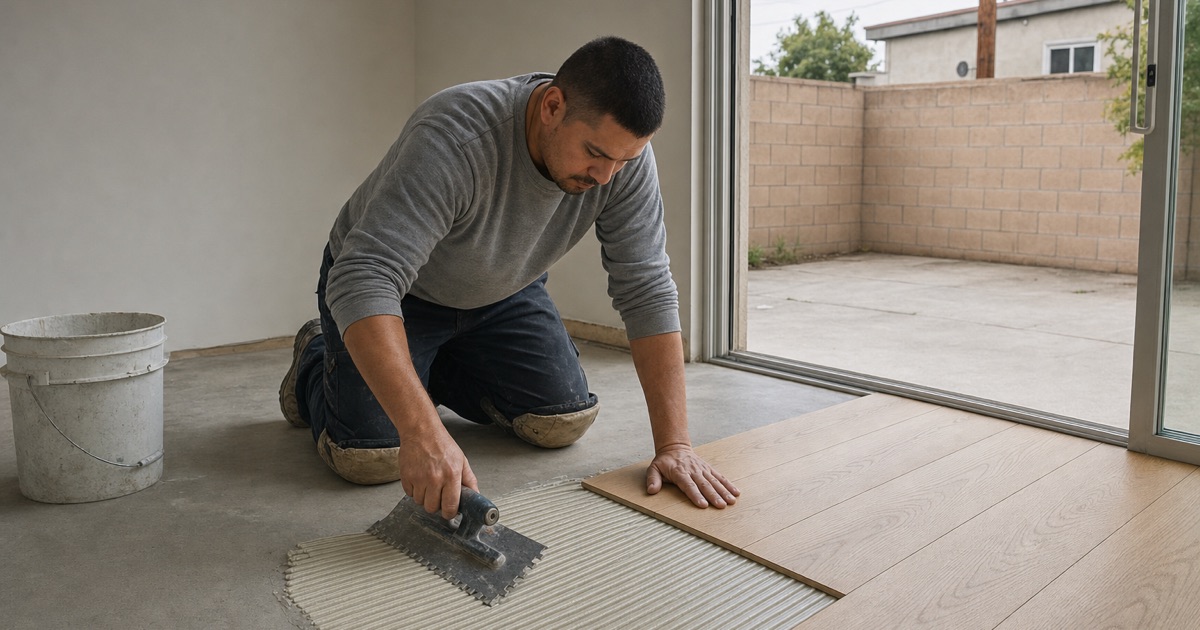
Every board is bonded directly to the prepared slab with a moisture-cure urethane adhesive, spread with a notched trowel sized to the product. This gives the most solid underfoot feel and the quietest floor, with no hollow sound. It also demands a flat, dry, properly prepared slab, because adhesive bridges nothing and every high or low spot telegraphs into the finished surface.
Floating
A floating floor locks board to board and rests on an underlayment without bonding to the slab at all. It installs faster, tolerates slightly more slab variation, and can be lifted later. The trade is acoustic: floating floors sound different underfoot, which matters more in some rooms than others, and the underlayment choice does much of the work in managing that.
Underlayment and Vapor Control
What sits between the slab and the floor is doing real work. A vapor retarder slows moisture migration from the concrete, and an underlayment adds cushioning and reduces sound transmission. In an upstairs unit, the underlayment specification is frequently the thing a building’s own governing documents actually regulate, so we settle it before installation rather than discovering it during.
Flatness and Preparation
Slabs are rarely as flat as they look. High spots get ground down and low spots filled with a levelling compound before anything is bonded or floated over them. This is unglamorous and it is where a good installation is won — a floating floor over an uneven slab flexes at every high point until the locking joints give up.
Choosing an Engineered Floor
Reading the Wear Layer Specification
Ask for the wear layer thickness before anything else, and treat it as the number that determines the floor’s life. Two products at the same price can differ enormously here, and the thicker one is buying you future refinishes. We convert that specification into plain terms: how many sandings this floor has in it, and what your options are once they are spent.
Core Construction
A cross-laid plywood core and a high-density fibreboard core are not equivalent. Plywood cores generally hold fasteners better, tolerate moisture variation more forgivingly, and are what we prefer over slabs in this climate. HDF cores can be flatter and more consistent, but they are less tolerant of a damp event. The core is invisible once installed, which is exactly why it deserves attention beforehand.
Formaldehyde Compliance
Engineered flooring has a composite core, and composite wood is subject to California’s Phase 2 formaldehyde limits, with the federal standard covering the same ground. Compliant product is what any reputable supplier stocks here, so specifying it costs nothing. We name the compliance on the quote rather than leaving it as an assumption, because it is the sort of thing that is easy to verify and worth having in writing.
Species, Width and Finish
Everything available in solid wood is available here — white oak, hickory, walnut — along with wider boards than solid can safely offer over concrete, since the stable core makes width less risky. Prefinished product arrives cured with no drying time on site, while site-finished engineered floors give a continuous surface with no bevel between boards. We quote both and explain what each costs you over time.
- 20+ Years in Southeast LA
- Free Written Estimates
- Licensed & Insured