
Lynwood Wood Flooring refinishes, caps and rebuilds hardwood stairs throughout Lynwood, CA, serving surrounding cities including South Gate, East Rancho Dominguez, Willowbrook, Compton and Paramount. Stairs are their own trade within flooring, and we quote them as their own scope rather than folding them into a square-foot rate for the house.
That matters more than it sounds. A staircase is the most visible woodwork in most homes — it sits in the entry, it is seen from both floors, and it is looked at from a few feet away rather than across a room. It also carries several times the labour of the equivalent area of open floor, because every component is individually cut, fitted and finished by hand.
Most flooring quotes treat stairs as an afterthought or a line item bundled into the total. That either inflates the whole job or guarantees the stairs get rushed at the end. We count treads, risers, nosings and skirting individually, so you can see exactly what the staircase costs and decide about it separately from the floors.
The Parts of a Staircase
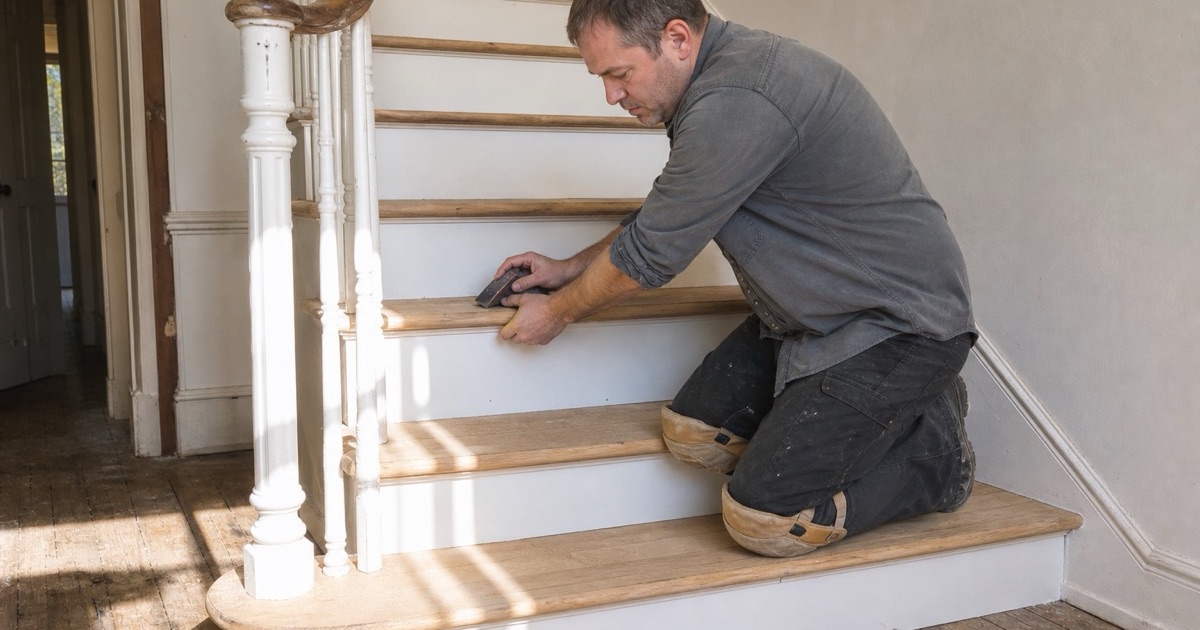
Treads
The tread is the horizontal surface you step on, and it takes more concentrated wear than any other piece of wood in the house — the same few square inches, thousands of times. Tread stock is thicker than flooring for that reason. When we refinish, the traffic path down the center of each tread is invariably where the finish has gone first, and it sets the standard the rest has to be brought to.
Risers
The riser is the vertical face between one tread and the next. It takes no foot traffic but collects scuffs from shoes, vacuum cleaners and everything carried up and down. Risers can be stained to match the treads or painted for contrast, and painted risers are both a traditional detail here and considerably more forgiving of the marks they inevitably collect.
Nosings
The nosing is the projecting front edge of the tread, and it is the part that reads as the line of the staircase from below. It also takes the hardest knocks. An overlap nosing sits proud of the flooring behind it and forgives small variations; a flush nosing sits level for a cleaner line and demands much tighter tolerances. Landing treads do the same job where a run meets a landing.
Skirt Boards and Trim
The skirt board is the angled trim running up the wall alongside the treads, closing the joint between staircase and plaster. It is frequently the most damaged piece on an old staircase and the most often ignored in a quote. Scribing a new skirt board to an existing stair is slow, precise work, and a staircase refinished without addressing it never looks properly finished.
Carpeted Stairs to Wood
Finding Out What Is Under There
Before anything is quoted we lift a corner of the carpet at the top and bottom of the run. Sometimes there are sound finished treads underneath that only need sanding and coating. Sometimes there is builder-grade stock that was never meant to be seen, in which case sanding it will not produce a floor anyone wants to look at. These are different jobs at very different prices.
Retro Treads Over the Existing Structure
Where the underlying stair is structurally sound but cosmetically unusable, a retro tread caps it — a finished tread installed over what is already there, with a matching riser face, and no demolition at all. It is faster, cheaper and far less disruptive than a rebuild, and in this housing stock it is very often the correct answer. It is also the option almost nobody offers.
When a Rebuild Is Genuinely Needed
Some staircases need more than a cap. Treads that flex underfoot, stringers that have split, or a staircase that has pulled away from the wall are structural problems, and putting a finished surface over them hides the issue rather than fixing it. We say plainly which category yours falls into, because the difference between capping and rebuilding is large and worth being certain about.
Refinishing an Existing Staircase
Why Stairs Are Not Just Small Floors
None of the machinery that makes floor sanding efficient fits on a staircase. There is no room for a drum machine, an edger reaches almost nothing, and every tread is a separate small surface with a nosing curving away at the front. Stair refinishing is largely hand and detail work, which is why it is priced by the component and why it takes longer than its square footage suggests.
Getting the Color to Match
Stair components and flooring frequently come from different stock, and the same stain sits differently on each. Where the staircase is being refinished alongside the floor, we color them together and the problem disappears. Where the floor is staying as it is, we cut and finish samples against the actual floor in your own light before committing to anything.
Coats, Cure and a Staircase Nobody Can Use
A staircase under refinishing is a staircase that cannot be walked on, which is a real constraint in a two-storey house rather than an inconvenience. We plan the sequence around that — often working alternate treads so there is a usable route, or scheduling around when the upper floor is genuinely needed — and we give you the cure schedule up front.
Configuration and Detail
Return Treads
Where the side of a staircase is open to a room rather than closed against a wall, the tread has a finished, mitred end that returns around the side. A staircase can be left-return, right-return, double-return where both sides are open, or closed-box where neither is. This changes both the material and the labour, and it is the detail most often missed when a staircase is quoted from a photograph.
Winders and Pie Steps
Where a staircase turns, the turning treads are wedge-shaped rather than rectangular. Every one is a separate template, cut individually, and no two in a run are identical. They are the slowest part of any stair job and the part where a rushed installer’s work shows most clearly, because a badly fitted winder is visible from the entire ground floor.
Handrail Fittings
Handrails are assembled from named parts — a volute curling out at the bottom, a turnout where the rail flares, a gooseneck rising to meet a landing, an easing softening a change of angle. These are joinery components with their own fitting requirements. Knowing which one a staircase needs, and being able to source and fit it, is the difference between a repaired handrail and a replaced one.
Making the Staircase a Feature
A staircase carries detail that a floor cannot. Contrasting painted risers, a stained skirt board, a darker tread against a lighter floor, or a run finished to a different sheen than the rooms around it. Because it is seen close up and from two levels, small decisions read strongly here. We work through those options before starting rather than defaulting the staircase to whatever the floor is doing.
- 20+ Years in Southeast LA
- Free Written Estimates
- Licensed & Insured