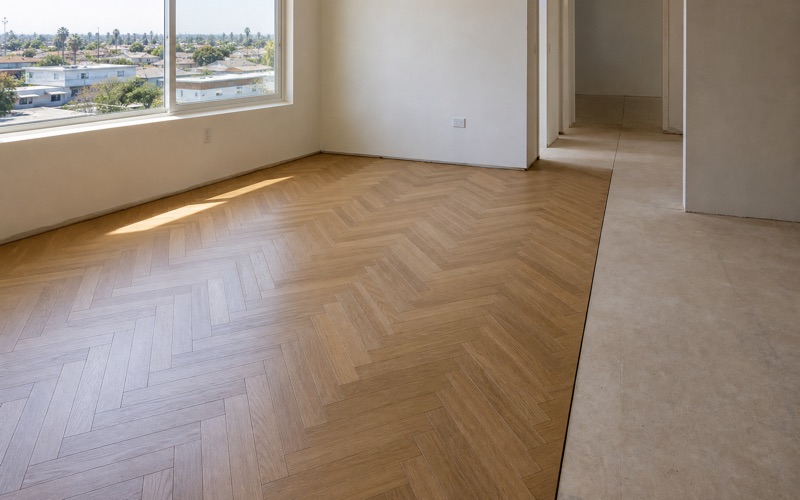
Lynwood Wood Flooring provides hardwood floor refinishing in Downey, and the houses here present a particular version of the job. Post-war building in this city produced generous, open floor plans — living rooms running into dining rooms running into hallways, with few doors and fewer thresholds — and that continuity changes how a floor is sanded, how it is finished, and how it is treated if a claim is ever made on it.
A floor that runs uninterrupted through several rooms is one surface, not several. It has to be sanded as one, colored as one, and coated as one, because any variation between areas will show precisely where they meet and there is no doorway to hide the change. That is more demanding than refinishing a set of separate rooms, and it is where the difference between a good job and an average one is most visible.
It has a second consequence that almost nobody mentions until it matters. Where a floor runs continuously with no natural break, that whole extent is generally treated as a single area for insurance purposes. If water damage occurs in one part of it, where that area starts and stops becomes a question with real money attached.
Refinishing a Large Continuous Floor
Sanding It as One Surface
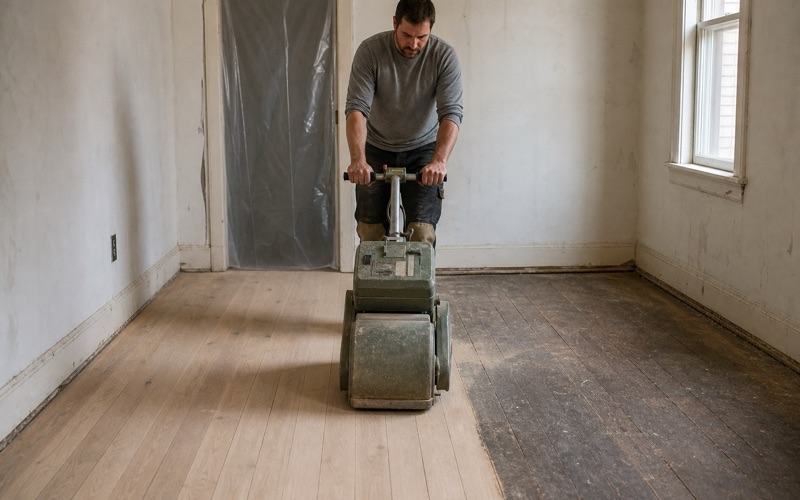
A continuous floor has to be worked as a single plane, with the machine passes planned across the whole extent rather than room by room. Where a sanding sequence stops and restarts at a room boundary, the join shows as a subtle difference in flatness that catches light across it. Planning the passes before starting is what avoids that, and on a large open floor it takes real thought.
The grit sequence matters more here than in a small room for the same reason. A scratch pattern left by one grit and not fully removed by the next is invisible under normal lighting and completely obvious under a low sun crossing a large floor. On an open plan there is nowhere for that to hide, so we check between passes under raking light rather than trusting the sequence.
Keeping Color Consistent Across the Area
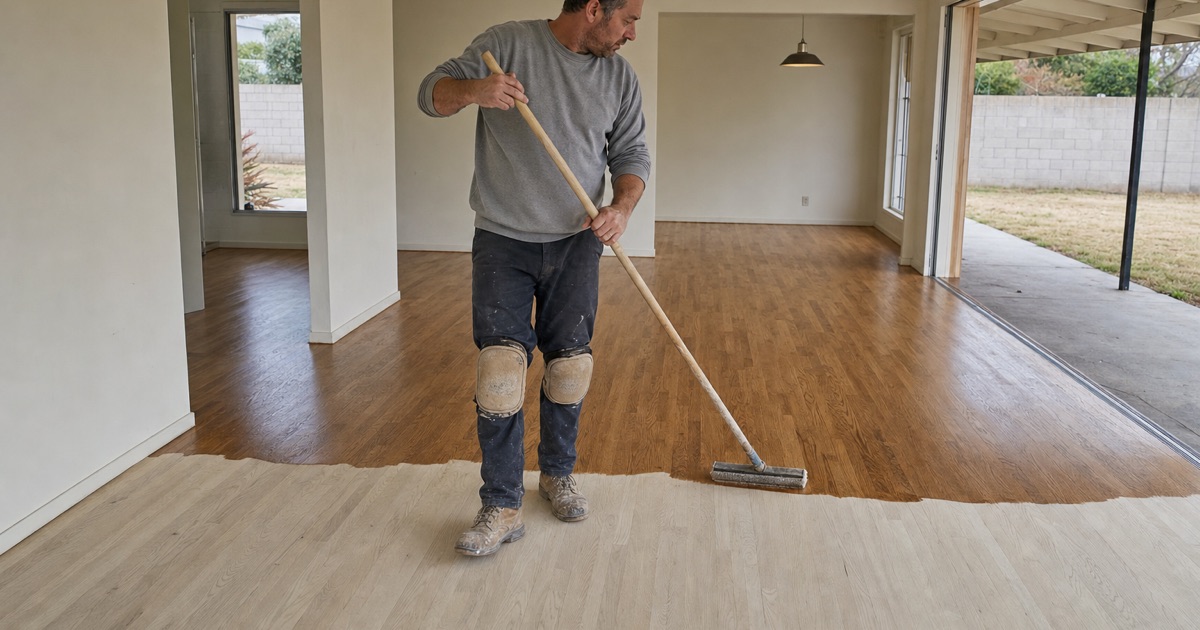
Stain on a large floor is applied in sections by necessity, and the risk is a visible edge where one section met the next. Working wet and keeping a continuous leading edge is what prevents it, which on a big floor means enough people to keep moving rather than one person working methodically. Where a lap mark does set, it cannot be removed without sanding back.
This is one of the few places where crew size is a quality question rather than a scheduling one. A large open floor being stained by one person will have areas beginning to set before the adjacent section is reached, and no amount of care compensates for that. We staff a big stain job to the size of the floor rather than to a standard crew, because the alternative shows permanently.
Coating a Big Floor Without Marks
The same applies to the finish coats. A large continuous surface has to be coated in one operation, working away from a planned exit so nobody is stranded, and maintaining a wet edge across the whole width. It is a straightforward discipline and it is where rushing shows most, because a coating that has begun to set before the adjacent pass arrives leaves a permanent line.
Planning the exit matters as much as planning the passes. On a large connected floor there is usually one sensible route out and it needs deciding before the first coat rather than during it. We map that at the start, along with which doors stay open and which get sealed, so nobody is finishing a section that traps them against a wall.
Looking for wood flooring closer to Maywood? See Maywood Wood Flooring.
Why Continuity Matters for a Claim
What a Continuous Area Means
In claims terms a continuous area is the extent of floor visible from one position with no doorway, wall or threshold breaking it. Where your living, dining and hall areas run together as one surface, that entire extent is usually treated as one area rather than as three rooms. It is a term adjusters use routinely and homeowners generally hear for the first time during a claim.
What counts as a break is more specific than people assume. A doorway with a threshold breaks an area; a cased opening with the floor running straight through generally does not. A change of material breaks it; a change of direction in the same material usually does not. Those distinctions are worth understanding before anyone needs them, because they are decided by what is physically there.
Why It Carries Money
California’s claims regulations require a damaged area to be restored to a reasonably uniform appearance. On a floor that runs continuously, achieving uniform appearance across the visible extent is what that obliges — which is a very different scope from repairing the few square feet that actually got wet. Where the breaks genuinely fall is therefore a consequential question rather than a technicality.
Recording It Before Anything Happens
We record the extent of continuous floor when we refinish it — where it runs, where genuine breaks occur, and where thresholds do and do not exist. It costs nothing at the time and it is a far better record than trying to establish the same thing after a loss, when everyone involved has a reason to remember it differently.
It is also worth knowing that most policies hold back a depreciation amount from the first payment, which becomes claimable once the work is actually completed. A great many homeowners never claim that balance simply because nobody explained it was there. Where we do insurance work, we build the scope so the completed job maps cleanly onto the original estimate, which is what makes claiming it straightforward.
Whether to Refinish at All
Measuring the Wear Layer First
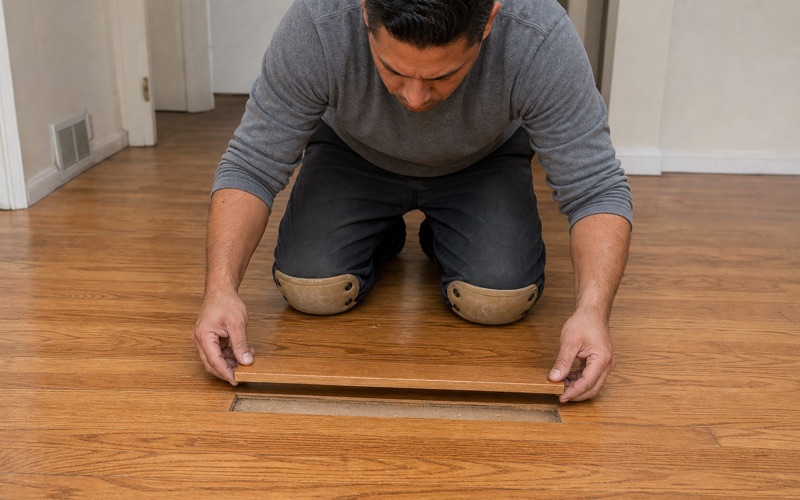
Before recommending a full sand we establish how much sandable wood sits above the tongue, read at an exposed board edge such as a floor register or a threshold. That number decides everything: a floor with generous depth has several refinishes ahead of it, while a floor near the tongue has one pass left at most. Sanding a floor with nothing left to give turns a repairable floor into a replacement.
On a large open floor this arithmetic carries more weight than usual, simply because the areas are bigger and the cost of getting it wrong scales with them. A full sand across an open plan is a substantial job, and spending the floor’s last remaining pass on cosmetic wear that a recoat would have handled is an expensive way to shorten its life.
When a Recoat Is the Better Job
If the finish is dull and scratched but still covering the wood everywhere, abrading and recoating restores the whole floor without removing any timber. On a large continuous area this is also considerably less disruptive — far less dust, a shorter time out of use, and no risk of lap marks in stain because no stain is involved. Where it applies, it is the better job as well as the cheaper one.
Where the Two Get Combined
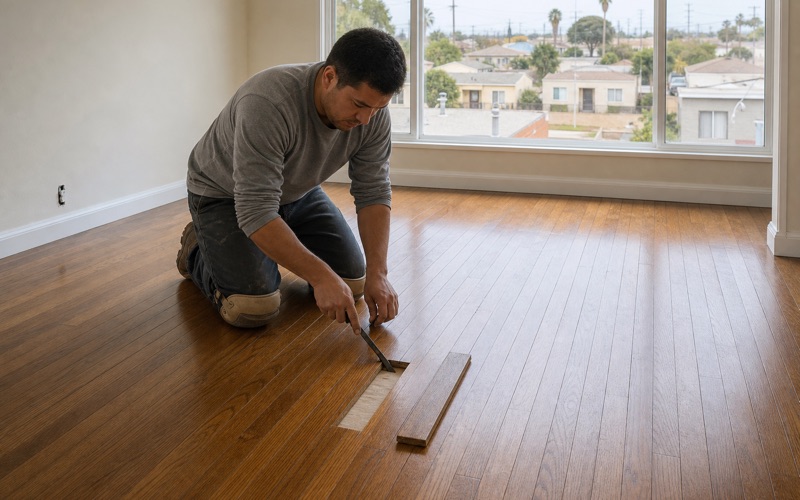
Frequently a large floor is mostly recoatable with one or two areas genuinely past that point — an entry, a spot under a window that was wet for a while. There the answer is often board replacement and blending in those areas with a recoat across everything else. That keeps the cost near a recoat while dealing properly with the parts that need more.
The caveat is that spot repairs under a recoat only disappear if the replacement boards are close in color to begin with, since a recoat does not equalise color the way a full sand and stain does. Where the match is not good enough, the choice becomes a full sand or accepting a visible repair, and we would rather show you both honestly than promise an invisible fix that a recoat cannot deliver.
Living With the Work
An Open Plan Is Harder to Section Off
The drawback of continuity is that there is nowhere to close a door. A house with separate rooms can be worked in stages with the family using the rest of it; an open plan cannot be divided in the same way, so the disruption is more concentrated and the household usually needs somewhere else to be for part of it. We are direct about that at the quoting stage rather than after the machines arrive.
What we can usually do is sequence around the two rooms nobody can give up — the kitchen and wherever people sleep — so those are unavailable for as short a period as possible. That is a planning question rather than a technical one, and it is far easier to arrange in advance than to improvise once the floor is open.
Cure Time on a Large Floor
A finish continues hardening after it stops feeling wet, and on a large floor there is more of it and more temptation to start using the space early. Furniture and rugs going back before the coating has hardened is the most common cause of damage to a newly finished floor. We give you the cure schedule for the specific product and plan the return of furniture around it.
What Goes Back Down, and When
Rugs in particular should stay off longer than people expect, because a rug laid over a finish still off-gassing can mark it permanently and unevenly. Furniture gets felt pads before it returns rather than afterwards, and anything on castors is the last thing to come back. None of that is complicated, and all of it protects a floor that has just had money spent on it.
Longer term, an open plan benefits more than most floors from matting at the exterior doors. Grit tracked in from outside is what abrades a finish, and on a continuous floor that grit gets distributed across the whole surface rather than being confined to one room. Catching it at the entrances is the single cheapest thing that extends the interval before the floor needs attention again.
- 20+ Years in Southeast LA
- Free Written Estimates
- Licensed & Insured