Lynwood Wood Flooring installs wood flooring in Paramount, and on nearly every job here the work starts with a test rather than a tape measure. This is slab country. Roughly one home in seven predates 1950, which means the overwhelming majority arrived with the post-war build-out and arrived on concrete, and concrete has to be measured before anybody talks about material.
The reason is that a slab is never simply dry or wet. It holds moisture through its depth and gives it up upward continuously, and how much it is giving up is a number rather than an impression. A slab can feel bone dry underfoot, show no staining, have carried carpet for thirty years without complaint, and still be emitting more than a wood floor will tolerate.
So the test comes first, and it comes before the material order rather than after the delivery. That sequencing is the whole point. A reading taken early turns a difficult slab into a schedule change and an extra line on a quote. The same reading taken after the boards are stacked in the garage turns it into a failure with somebody’s deposit already spent.
Reading a Slab Properly
Surface Tests and Why They Mislead
The older methods read the surface — taping plastic down overnight and looking for condensation, or setting a dish of calcium chloride and weighing what it absorbs. They measure what is leaving the top of the slab under the conditions of that day, which is a different question from how much moisture the slab actually holds. A slab that has been open to dry air for a week can read reassuringly low on the surface while its body is still loaded.
That is exactly the situation a flooring job creates. Carpet comes up, the slab is swept and left open for several days while other work happens, and the top few millimeters dry out nicely. A surface test at that moment reports a slab that is ready. Then a floor goes down, the surface is sealed by adhesive and boards, moisture redistributes upward from the depth of the slab, and the reading that mattered was never taken.
The In-Situ Relative Humidity Probe
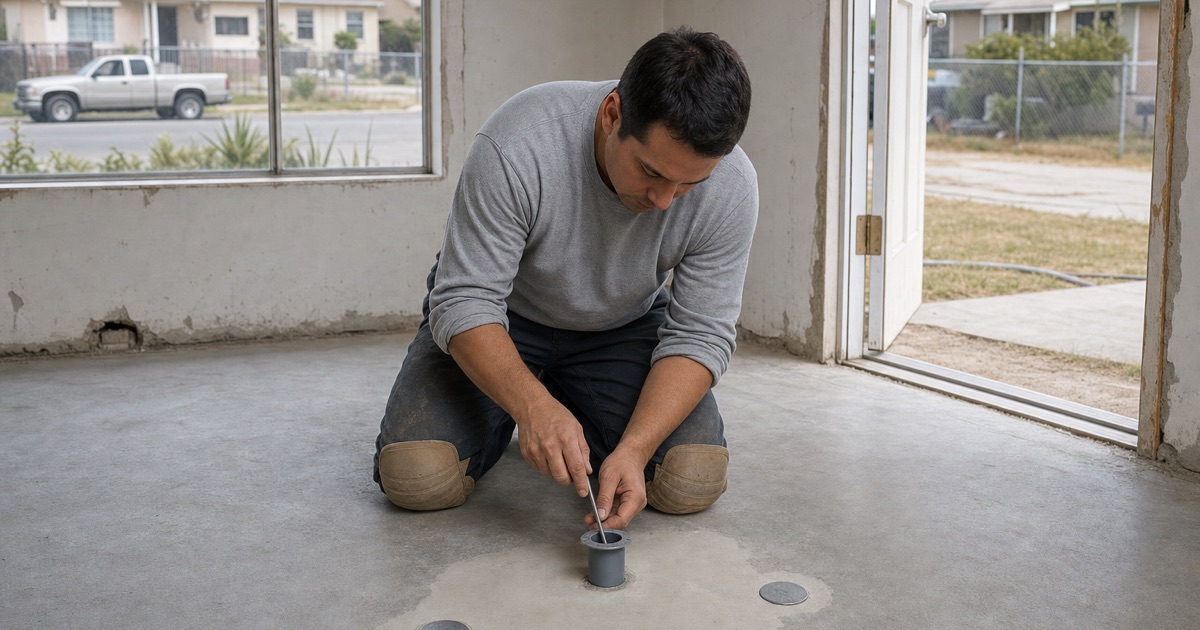
What we use instead is an in-situ relative humidity probe, following the ASTM F2170 method. A hole is drilled to a specified depth, a sleeve is set into it, and the probe reads the humidity of the air inside the slab once it has equilibrated. That reading describes the concrete’s interior rather than its skin, which is what actually determines what happens to a floor bonded on top of it over the following years.
The method also specifies how many probes a given area needs and where they go, which matters because slabs are not uniform. A single reading taken in the middle of a house tells you about the middle of that house. Areas near exterior walls, near plumbing penetrations, or over ground that drains differently can read quite differently, and it is generally the worst spot rather than the average one that determines what the floor needs.
The Threshold, and What Sits Above It
Wood goes down over concrete reading at or under 75 percent relative humidity. Above that number the slab is not ready and no adhesive choice or underlayment substitutes for dealing with it. This is not a matter of opinion between contractors — it is the manufacturer’s own condition, and installing outside it generally voids the warranty on the material you have just paid for.
Looking for wood flooring closer to Watts? See Watts Wood Flooring.
When the Reading Comes Back High
Finding Out Why
A high reading has causes worth identifying rather than simply covering. A relatively new slab may still be releasing its construction water and may simply need time. An older slab reading high usually has a source — drainage sending water toward the foundation, an irrigation line, a missing or failed under-slab vapor barrier, or grading that directs surface water at the house. Some of those are cheap to fix and change the whole picture.
That is why we look outside before quoting anything expensive inside. A downspout emptying at the foundation, a planter bed held against the wall, or a lawn line running along one elevation can be the entire explanation for a reading, and correcting it costs a fraction of what a membrane does. Selling mitigation to solve a drainage problem treats the symptom and leaves the water arriving at the same rate it always did.
Mitigation Membranes
Where the moisture is genuinely there and is not going away, a liquid-applied moisture mitigation membrane is rolled or troweled onto the prepared slab, curing to a barrier that the flooring adhesive then bonds to. It works, it is well proven, and it costs real money — which is precisely why it belongs on the quote at the beginning rather than appearing as a surprise once the job has started.
Choosing a Floating Assembly Instead
Sometimes the better answer is to avoid bonding at all. A floating floor over a vapor retarder and underlayment does not rely on adhesion to damp concrete, and on a slab that is marginal rather than badly wet it can be the more sensible route. It changes how the floor sounds and feels underfoot, so it is a genuine trade rather than a free workaround, but it is often the pragmatic choice.
Waiting, When Waiting Is the Answer
On a newer slab still giving up construction moisture, the correct recommendation is sometimes to wait and re-test rather than to sell mitigation. We would rather come back in a few weeks with a second reading than take payment for a membrane a slab did not need. It is a slower conversation and it is the one that leaves you with the floor you should have.
Preparing the Slab Itself
Flatness Is Not the Same as Level
These are two different properties and only one of them matters here. A slab can slope gently across a room and take a wood floor perfectly well. What it cannot have is local deviation — humps and dishes over short distances — because that is what a floor bridges badly. We work to a flatness tolerance across a straightedge, grinding the high points and filling the hollows with levelling compound.
The consequence of skipping this differs by method, and neither version is good. A bonded floor over an uneven slab has voids beneath it wherever the adhesive could not reach, and those spots sound hollow and eventually lose their bond. A floating floor flexes at every high point, and the locking joints between boards are the part that takes that flexing until they fail. The same defect, two different failures.
What Was There Before
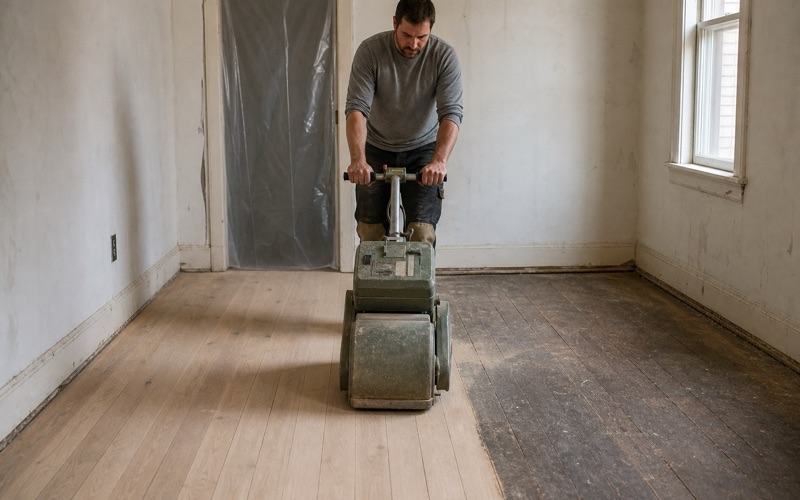
Slabs come to us with a history. Adhesive residue from vinyl tile, thinset ridges left from ceramic, carpet tack strip holes, and paint or sealer applied at some point all affect whether a new adhesive can bond. Residues get mechanically removed rather than covered, because a bond is only as reliable as the layer beneath it and adhesive over old adhesive is a joint with two chances to fail.
Cracks and Movement
Most slab cracks are shrinkage cracks that stopped moving decades ago and simply need filling before the floor goes over them. A crack that is still moving, or one with a height difference between its sides, is a different matter and needs understanding before it is buried under a new floor. We look at what a crack is doing rather than assuming every one is cosmetic.
Choosing the Floor Itself
Engineered as the Default
Over concrete the right product is engineered hardwood — a real sawn hardwood wear layer over a dimensionally stable core that holds its shape where a solid board would not. It is the correct specification rather than a concession, and everything available in solid is available here in species and finish. The core is what makes the whole assembly work on a slab.
Width is actually easier here than on a raised floor, which surprises people who assume engineered is the more limited product. Because the cross-laid core resists movement across the board’s width, wider planks are less risky over concrete than the equivalent solid board would be over joists. If a wide plank floor is what you want, a slab house with a good reading is a better starting point for it than most raised houses are.
Adhesive, Trowel and Spread Rate
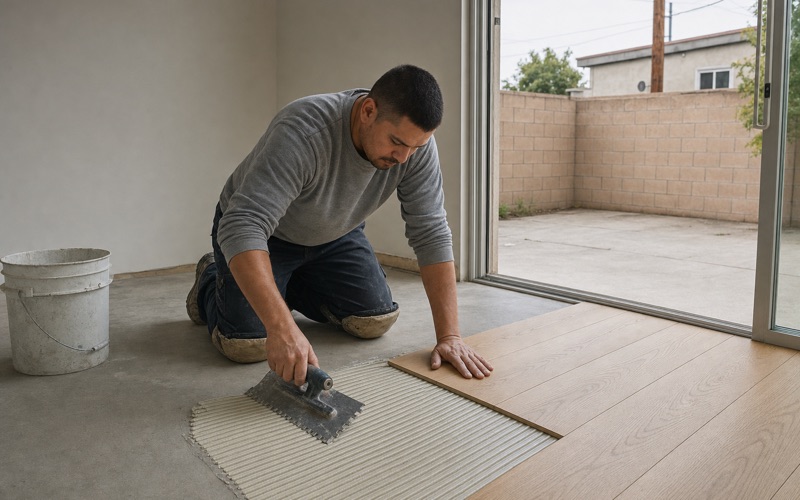
Where a floor is bonded, the adhesive specification carries real detail. A moisture-cure urethane is standard over concrete, and it is spread with a notched trowel sized to the particular product to achieve a stated coverage rate. Too little adhesive leaves voids that sound hollow underfoot; too much squeezes into the joints. The trowel is a specification, not a preference, and it comes from the manufacturer’s own data.
What the Finish Can Be
Whatever goes on top has to be legally supplied and applied in this air basin, where wood coatings are capped at 275 grams per liter of VOC. That constraint is genuinely local and it shortens the available shelf, pushing most work here toward waterborne two-component finishes and hardwax oils. Prefinished engineered product sidesteps the question entirely by arriving cured, which is one of its real advantages on an occupied house.
- 20+ Years in Southeast LA
- Free Written Estimates
- Licensed & Insured