Lynwood Wood Flooring installs, refinishes and repairs wood flooring in South Gate, and a large share of that work starts with a floor the owner did not know they had. Carpet gets lifted for a remodel, or a corner gets pulled back out of curiosity, and underneath is original strip oak that has been covered since before anyone in the house was born. The question that follows is always the same one: is it any good, and what can be done with it?
That question has a numerical answer, which is the useful thing about it. A wood floor’s future is set by how much sandable material sits above the tongue of the board, and that depth can be measured rather than guessed at. It is not a matter of how the floor looks, how old it is, or how badly it has been treated — a filthy, scratched, paint-spattered floor with depth left has a future, while a cosmetically tidy floor with nothing left above the tongue does not.
So we start with a measurement and work outward from it. That single reading determines whether your floor gets a full sand, a recoat, a repair, or an honest conversation about replacement — and it is the difference between spending money on a floor that will repay it and spending money on a floor that has already given everything it has.
What Is Actually Under the Carpet
Lifting a Corner Before Anything Is Quoted
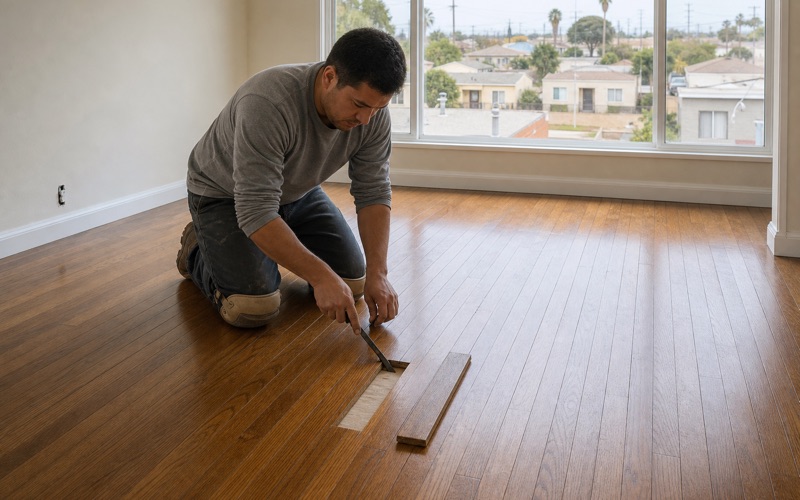
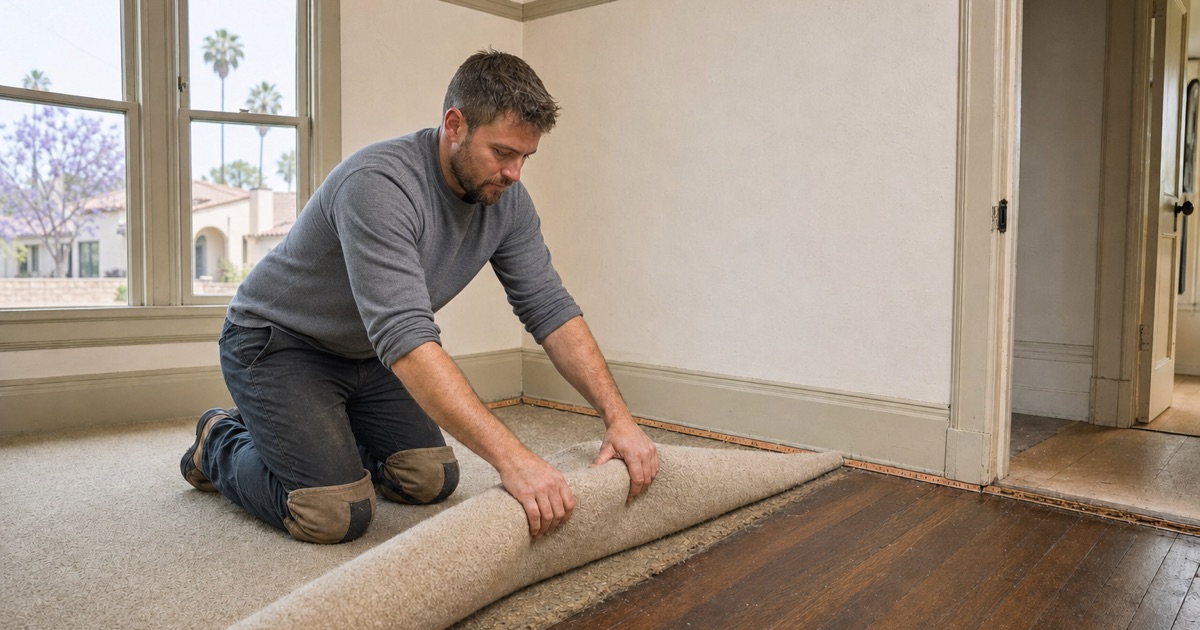
We pull back a corner at a doorway and another at an inside corner of the room before quoting anything, because the two locations tell different stories. A doorway shows what the floor endured in the traffic path and whether the boards run continuously into the next room. An inside corner, which furniture has usually protected for decades, shows what the timber looked like before the room was lived in. The gap between those two is a fair preview of what a sanding will recover.
What we are looking for at that stage is not beauty but structure. Are the boards still tight to one another or have they shrunk apart, and do they move underfoot in a way that points at fasteners rather than at the surface. Is there staining that follows a straight line, which usually means a leak rather than wear. None of that shows in a photograph, which is why we would rather spend twenty minutes in the room than quote from one.
What a 1920s Strip Floor Looks Like
South Gate incorporated in January 1923 and a good deal of the housing here dates from that era and the two decades after it, which means the original flooring is very often narrow strip oak — roughly two and a quarter inches wide, tongue and groove, nailed blind through the tongue into a board subfloor. It was the standard specification of its day and it was built to a standard nobody applies to flooring now. Most of what we find from that period is entirely recoverable.
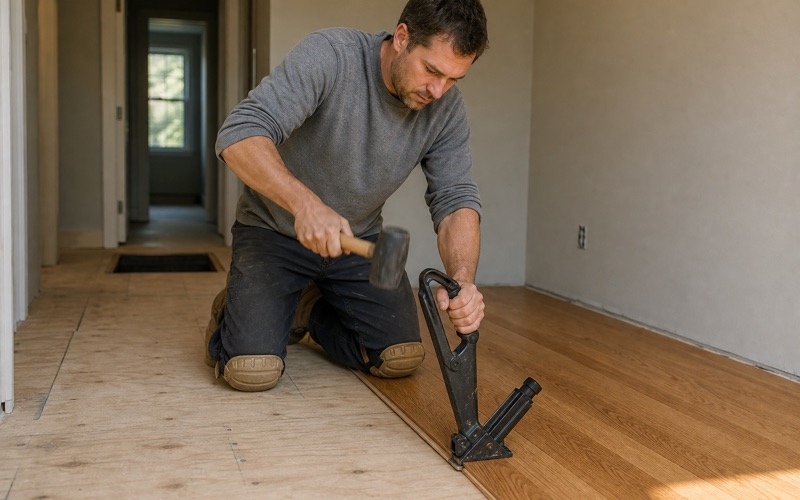
Housing of this age in the area also tends to sit on joists over a crawl space rather than on a slab, which matters more than it first appears. It means the original floor could be nailed down properly, and it means a replacement floor can be too. Where a house of this era still has its raised structure intact, solid wood remains a live option rather than a nostalgic one — the substrate that made the first floor possible has not changed.
When It Is Not Oak, and When It Is Not Wood
Not every discovery is a good one. Some rooms turn out to have softwood subfloor that was never intended as a finished surface, laid rough and covered from the beginning. Others have had a poured topping applied over the original boards at some point, which is a different material entirely and does not respond to sanding the way wood does. We identify what we are actually looking at before any machine comes into the house, because treating one as the other damages both.
Looking for wood flooring closer to East Rancho Dominguez? See Wood Flooring Services in East Rancho Dominguez.
Reading the Wear Layer
Where the Measurement Gets Taken
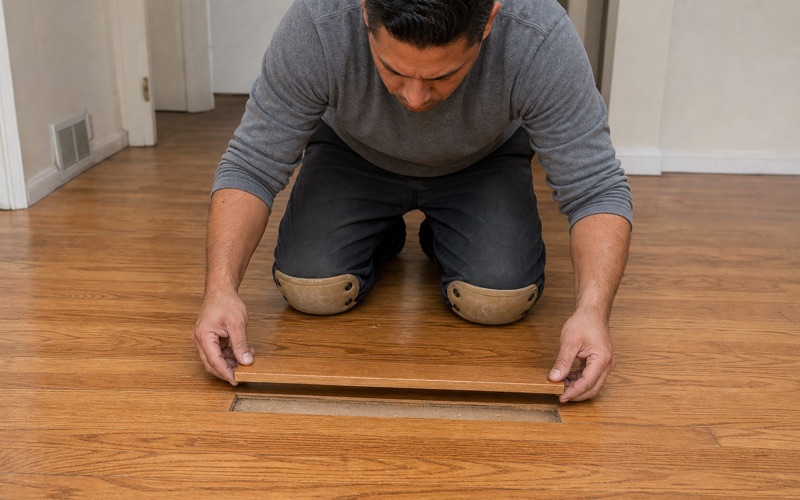
The reading needs an exposed board edge, and the two reliable places to find one are a floor register cut into the boards and a threshold where the flooring stops against another surface. Either shows the full profile of the board — the wear surface, the tongue, and the depth between them. That depth is the entire remaining life of the floor expressed as a number, and it takes a few minutes to establish rather than a site visit’s worth of speculation.
What the Number Means in Practice
Each full sanding sequence takes a predictable amount off the top, so remaining depth converts directly into remaining refinishes. A floor with generous depth has several sandings ahead of it and can be treated as a long-term surface. A floor down near the tongue has one pass left at most, and once the tongue is exposed the boards lose the mechanical connection holding them together. That is the end of the floor, not a stage of it.
The same reading is even more decisive on an engineered floor, where the only sandable material is the wear layer bonded over the core. Some engineered products carry enough to take a full sanding sequence more than once; others will not survive a single pass, and cutting through into the core is not a repairable mistake. Knowing which one is on the floor before a machine touches it is not a refinement, it is the whole decision.
The Arithmetic Nobody Runs
What this changes is which job you should be buying. A floor with one sanding left should almost never spend it on cosmetic wear, because a recoat handles that and costs a fraction as much. The single pass it has remaining is worth saving for damage that genuinely requires it. Running that arithmetic before the machines arrive is the difference between a floor that lasts another forty years and one that is finished in ten.
Refinish, Recoat, or Neither
When a Full Sand Is the Right Call
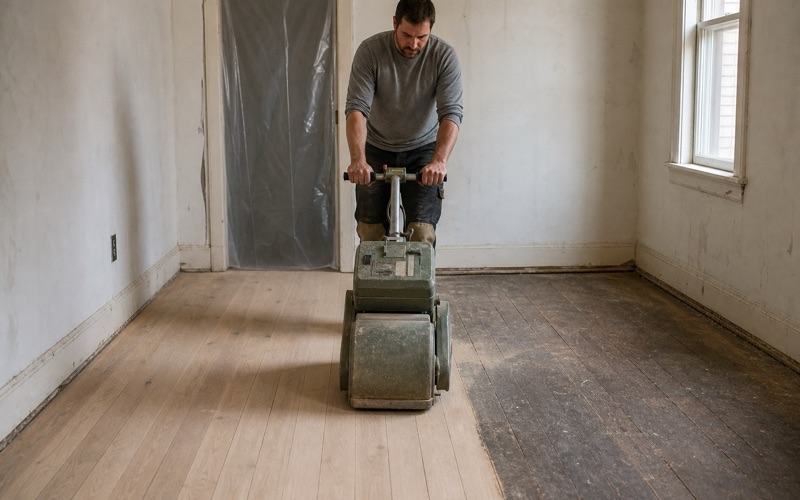
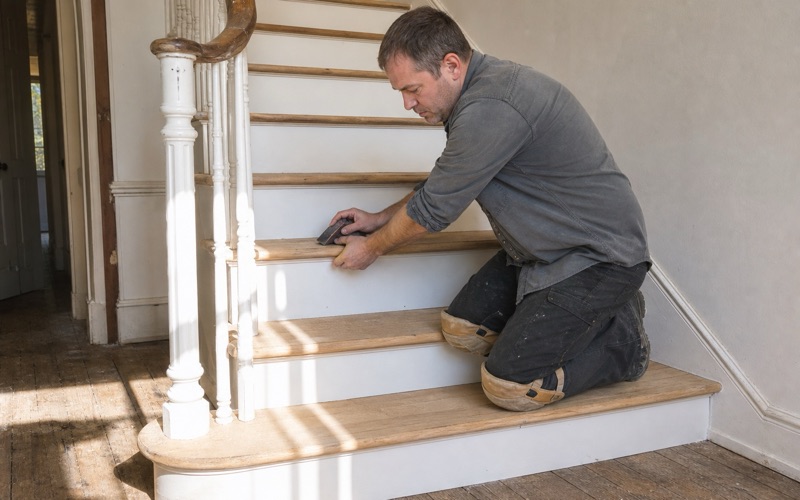
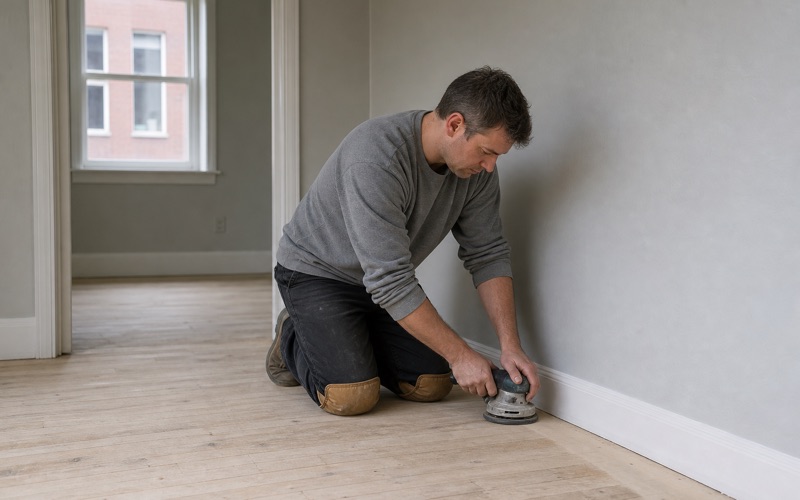
A full sand earns its cost when the damage is in the wood rather than the finish: deep scratching, stains that have penetrated the grain, an old color that has to come off, or boards sitting at slightly different heights after a repair. It is also the only route to a genuine color change, since stain lives inside the timber. Given the depth to work with, it produces a floor indistinguishable from new.
When a Recoat Does the Same Job for Less
If the finish is dull, scratched and tired but still covering the wood everywhere, abrading and recoating restores the whole floor without removing any timber at all. On a floor that has already been sanded several times across a century, this is not the cheap option — it is the correct one. The limitation is absolute rather than gradual: once bare wood is showing anywhere in a traffic lane, recoating seals that damage under a new surface permanently.
Treated as a cycle rather than a rescue, recoating is what makes an old floor effectively permanent. A floor recoated every several years, before wear ever breaks through, never needs sanding again and keeps every bit of depth it has. Most floors that reach us worn to the tongue got there through neglect punctuated by full sandings, rather than through use — the maintenance approach costs less over a lifetime and preserves far more wood.
When the Honest Answer Is Neither
Sometimes a floor is genuinely spent, and saying so is more useful than selling a sanding that will not work. Boards worn to the tongue, extensive rot from an old leak, or a floor that has already been sanded past what the fasteners can hold are all situations where refinishing makes things worse rather than better. When that is what we find we say it plainly and explain what we measured, so the decision is yours and it is informed.
Where an Old Floor Meets a Newer One
Additions and the Seam Between Eras
Houses of this vintage have frequently gained a room, and the addition rarely has matching flooring. The junction between original and later work is the detail that decides whether the whole floor reads as one surface or two, and it is usually handled badly — a threshold strip dropped in to close the gap and hide the mismatch. Where the two floors are at compatible heights there is nearly always a better answer available.
Lacing New Boards Into Old
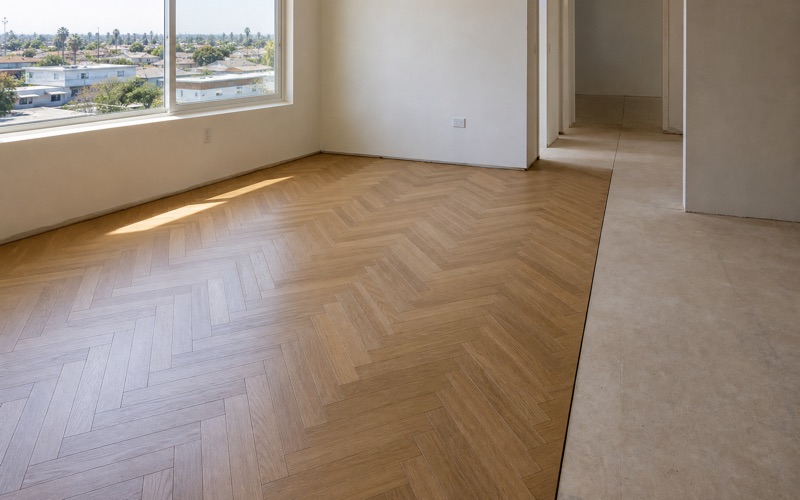
The better answer is to lace the newer flooring into the original rather than butting them together in a line. End joints are staggered into the existing pattern so no continuous seam runs across the opening, and the whole area is then sanded and finished together so both take the same color on the same day. Done properly, the point where two floors laid decades apart meet is not findable.
Matching Width, Grade and Direction
Matching means three things at once, not just species. The board width has to be right, since a modern three-inch plank beside original two-and-a-quarter strip will never look correct however well it is finished. The grade has to be similar, so an evenly colored select board is not set against character timber full of knots and mineral streak. And the run direction has to continue, because a floor that changes direction at a doorway announces the seam no matter how good the joinery is.
Color is the one thing that does not have to match at the point of installation, and that is what makes the whole approach work. New boards laced into an old floor will look obviously new until the moment both are sanded together, and then they take the same stain and the same coats on the same day. Matching happens at the finish stage, not at the timber yard, which is why we would rather lace in unfinished stock than chase a prefinished board that looks close in a showroom.
- 20+ Years in Southeast LA
- Free Written Estimates
- Licensed & Insured