Lynwood Wood Flooring refinishes and installs wood flooring in Watts, and on nearly every job here one thing shapes how we set up before anything else does. Sanding a floor does not only remove finish from boards. It disturbs every coating that has accumulated on that floor and the trim around it since the house was built, and in housing this old some of those coatings are lead-based.
This is not a caution attached to the end of a quote. It changes how a site is prepared, how machines are run, how dust is captured, and how the house is cleaned before anyone moves back in. It is a method rather than an add-on, and we build it into the job because the alternative is spreading contaminated dust through a home somebody lives in.
Watts grew as an independent town around its railroad station in the late nineteenth and early twentieth centuries, before being consolidated into Los Angeles in 1926, and much of the residential fabric reflects that early build-out. Housing of that vintage sits comfortably on the wrong side of every date that matters for coatings, which is why containment is the default here rather than a question we ask.
Why Old Coatings Change the Job
What Sanding Actually Releases
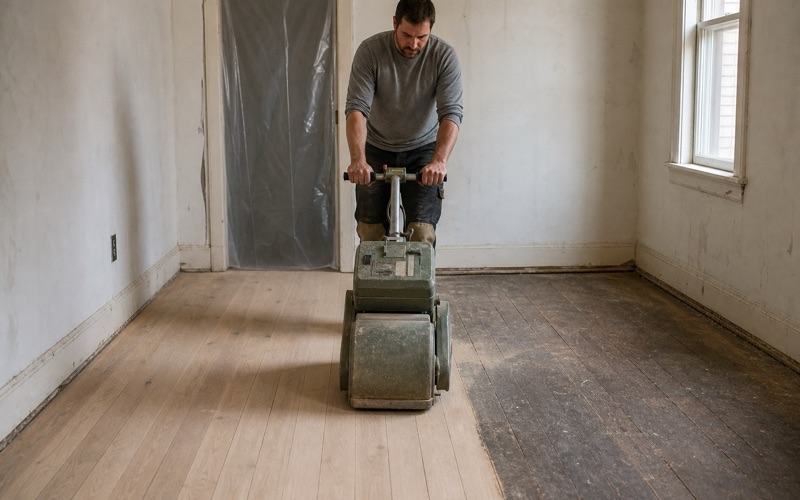
A drum or belt sander removes material as fine airborne dust, and it does not distinguish between a floor finish applied last decade and whatever was put down eighty years ago. On a floor that has been coated, stripped, recoated and painted at the edges across a century, sanding lifts all of it at once. Where any of those layers contain lead, the dust carries it into the air of a lived-in house.
The scale is what makes it worth taking seriously. Sanding a floor produces a genuinely large quantity of very fine material in a short time, and fine particles stay airborne long after the machine has stopped and travel wherever air moves in the house. This is a different situation from scraping a small area of trim, and it deserves a different level of preparation rather than the same caution scaled up.
The Date That Matters
Lead-based coatings were in ordinary domestic use until they were restricted in 1978, so the practical rule is simple: if the house predates that year, assume the possibility and work accordingly. Nearly all the residential stock in this community was built well before then. We do not treat this as a probability to be weighed on each job — we treat pre-1978 construction as the standard case and set up for it every time.
Working that way removes a conversation nobody benefits from. The alternative is a contractor deciding case by case whether a given house looks old enough to bother, which puts the judgement in exactly the wrong place and creates an incentive to decide against it. Making containment the standard method means it is priced into every quote and never becomes something to be traded away when a number needs to come down.
Where the Risk Concentrates
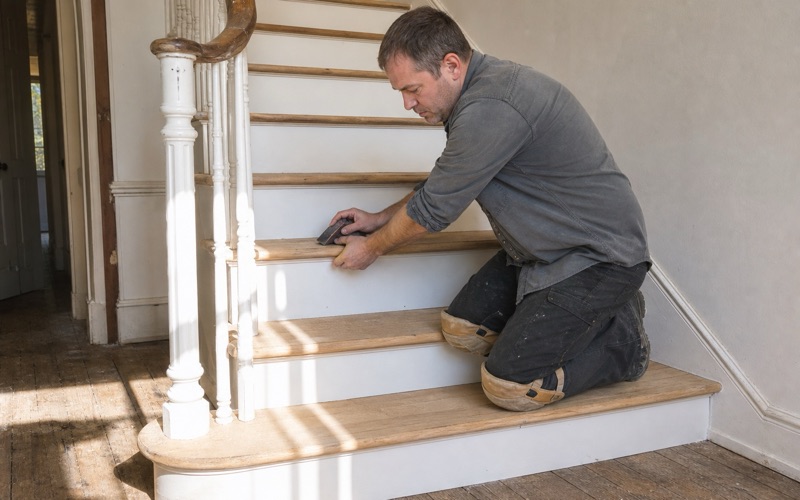
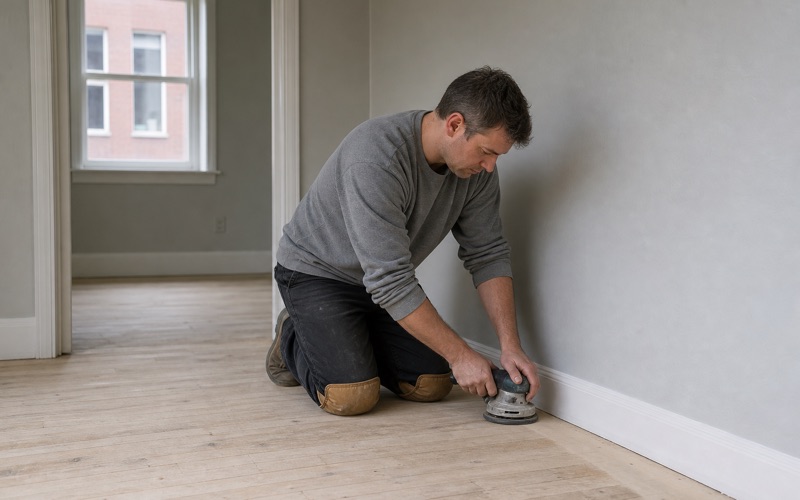
It is rarely the field of the floor that matters most. The concentration sits at the edges, where painted baseboard meets the boards, around door casings, on thresholds, and on stair components where paint has been applied and reapplied over decades. Those are exactly the areas cut by an edger and finished by hand rather than by the big machine, and they are where careful working practice does the most good.
Looking for wood flooring closer to Cudahy? See Wood Flooring in Cudahy.
How the Site Gets Set Up
Containment Before Any Machine Runs
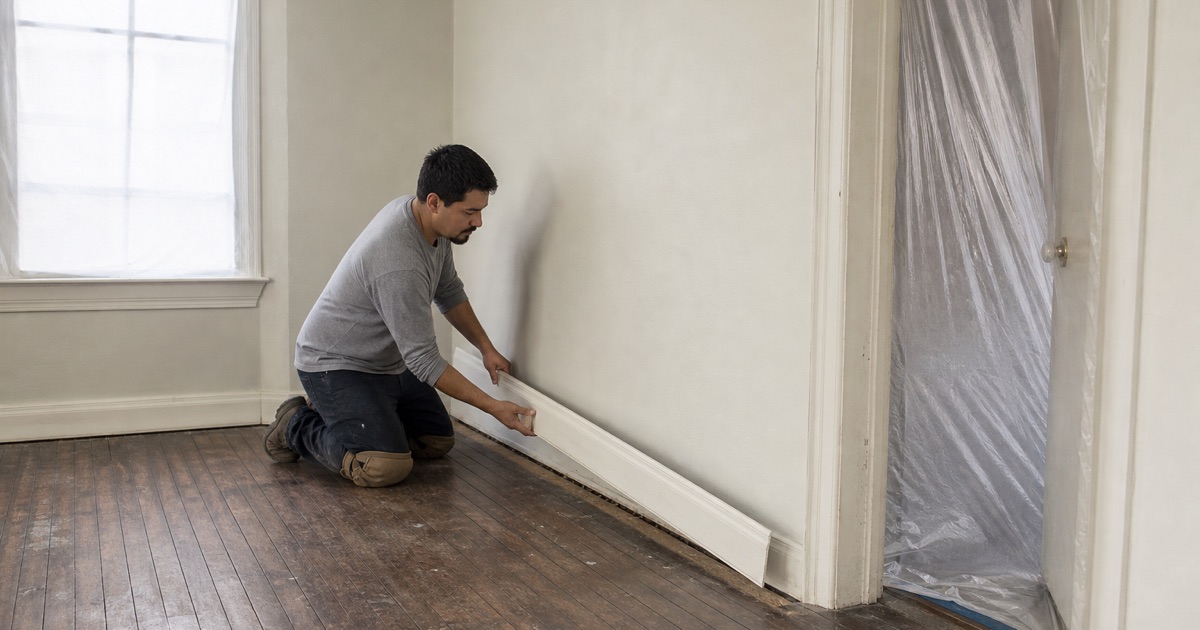
Before a sander is switched on, the working area is separated from the rest of the house. Openings are sealed, doorways are covered, and paths between the work and the outside are protected so dust cannot be tracked through rooms nobody is working in. Contents that cannot be removed are covered rather than shifted to one side, since a sheet over furniture is only useful if it is actually sealed.
Air movement gets attention at the same time. Forced-air heating and cooling will distribute dust through an entire house within minutes if it runs during sanding, so the system stays off and floor registers within the work area are sealed rather than merely covered. Open windows help in the working area and hurt everywhere else, so which ones are open and when is part of the plan rather than left to whoever is nearest.
Extraction at the Source
Our machines run into an extraction and containment system that captures the great majority of dust where it is generated rather than letting it into the room and collecting it afterwards. This is what the word dustless refers to, and it is a substantial improvement over open sanding, but it is not literally zero — fine particles still escape. We would rather describe it accurately and contain the remainder than sell a word the equipment cannot deliver.
Cleaning Up Properly Afterwards
The end of the job is where lead-safe practice most often lapses, because the visible dust is gone and the floor looks finished. Fine dust settles on horizontal surfaces well beyond the working area and needs removing rather than redistributing with a broom or an ordinary vacuum. Surfaces get cleaned wet and the containment stays up until that is done, not until the sanding stops.
The edges of the work are where the care actually shows. Window sills, the tops of door casings, the gap behind a radiator and the first few feet of any adjoining room all collect settled dust and all get missed by a cleanup aimed at the floor. Those are the surfaces a small child touches, which is the entire reason the standard exists, so they are the ones worth being thorough about.
Working in an Occupied House
Sequencing Around People
Most of the houses we work in here are occupied throughout, which shapes the plan more than the flooring does. We work room by room where possible so the household keeps usable space, and we agree beforehand which rooms are out of use on which days. A schedule that assumes an empty house is a schedule that gets abandoned on the second morning.
What to Move and What We Cover
Small contents, textiles and anything that traps dust are far better out of the working area entirely than covered within it. Larger furniture we move and protect. Curtains, rugs and bedding in particular are worth removing rather than sheeting, because fabric holds fine dust in a way hard surfaces do not and is difficult to clean afterwards.
Cure Time and Getting the Room Back
A finished floor is not immediately a usable floor. Coatings continue hardening after they stop feeling wet, and the room needs to stay empty and unwalked during that window. We give you the cure schedule for the specific product going down, and we plan which room comes back into use when, so the sequence works around the household rather than against it.
What Gets Restored
Original Floors Worth the Trouble
The compensation for all this care is that the floors underneath are frequently excellent. Early strip oak was milled and installed to a standard that is simply not applied to volume flooring now, and a floor that has been under carpet for decades is often in far better condition than its owner expects. Where the wood has depth left, these floors come back completely.
The timber itself is frequently better than anything comparably priced today. Early strip flooring was cut from older, slower-grown stock, which shows as tighter grain and greater density than most current material of the same species. A floor like that is not merely worth saving on grounds of character — it is worth saving because replacing it with new wood of equivalent quality would cost considerably more than restoring it.
Measuring What Remains
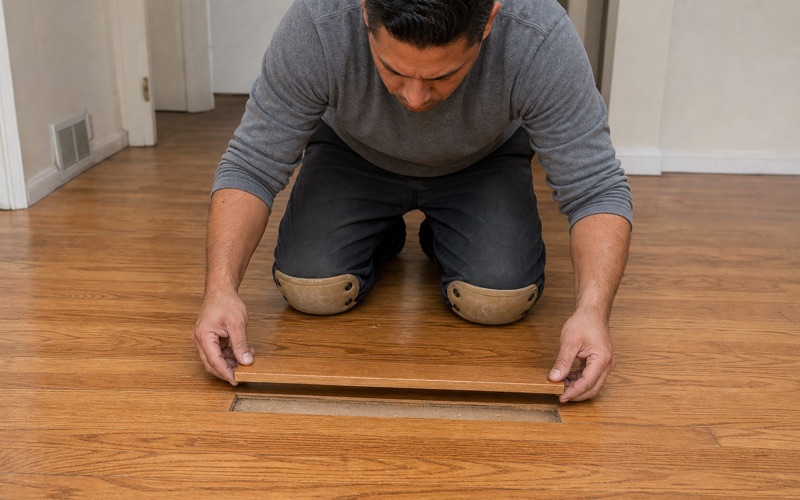
Before recommending a full sand we establish how much sandable wood sits above the tongue, reading it at an exposed board edge such as a floor register or a threshold. That number decides whether the floor gets a full sanding sequence, a recoat that spends no wood at all, or a more limited repair. On floors this old the answer is frequently a recoat, which is both cheaper and better for the floor.
Repairs That Disappear
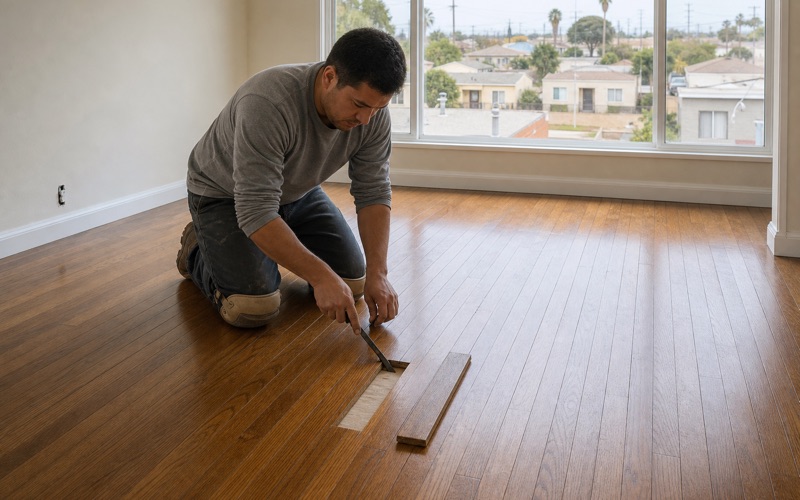
Older floors carry old alterations — a removed wall, a patched hearth, a section replaced badly at some point. New boards are laced into the existing layout with staggered end joints rather than butted in as a block, and the whole area is sanded and finished together so it takes the same color on the same day. Done properly, a repair in a hundred-year-old floor is not findable afterwards.
Matching into old timber does take longer than matching into new, and it is worth knowing why before comparing quotes. Board widths from that era do not always correspond to what is milled now, grain and color have to be selected rather than simply ordered, and the surrounding floor usually needs sanding as a whole so the repair and the original take color together. It is more work than a patch, and it is the difference between a floor that reads as continuous and one that reads as mended.
- 20+ Years in Southeast LA
- Free Written Estimates
- Licensed & Insured