Lynwood Wood Flooring installs wood flooring in Willowbrook, and in most of the houses here that means engineered hardwood over concrete. That is not a lesser floor and it is not a compromise on a budget. It is the product the substrate calls for, and specifying anything else on a slab is how a floor fails in its second year.
Engineered wood gets described badly almost everywhere it is sold. The surface you walk on and look at is solid sawn hardwood — the same species, the same grain, cut from the same log as a solid board. What differs is what sits beneath that surface, and that difference is precisely what allows the floor to live on concrete without cupping.
Once that is settled, the real decision is how it gets attached. Glue-down and floating are genuinely different floors in how they feel, how they sound and what they demand of the slab, and the choice should follow what the concrete actually measures rather than which method is quicker to install.
Why Engineered Is the Right Floor Here
What a Slab Does to Solid Wood
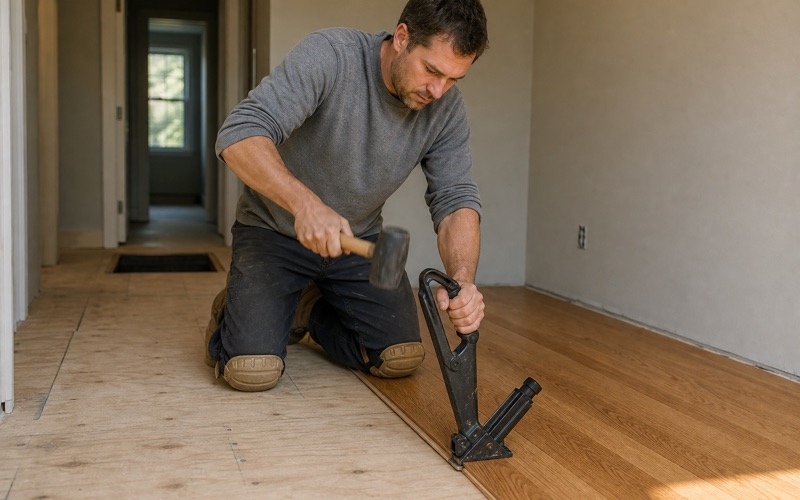
Concrete transmits water vapor upward continuously, whatever its age and however dry the surface feels. A solid board absorbs that from beneath, swells on its underside, and cups. It also has nothing to fasten into, since mechanical fastening needs joists and a slab has none. Adhesive alone across a wide solid plank cannot resist that seasonal movement, so the failure is a matter of when rather than whether.
How the Board Is Built
An engineered board is a wear layer of real sawn hardwood bonded over a core of cross-laid plywood or high-density fibreboard. Because the core plies run in opposing directions, the board resists the across-the-width movement that defeats a solid plank on concrete. The result behaves dimensionally like a manufactured panel while presenting a surface that is entirely timber.
It is worth separating this from the products it shares shelf space with. Laminate is a photographic image beneath a wear coat, and vinyl plank is polymer through its whole thickness. Neither contains any wood at the surface, so neither can be sanded, recolored or refinished at any point in its life. Engineered hardwood can be, subject to its wear layer, and that is a categorical difference rather than a matter of quality.
The Building Era Behind It
Willowbrook’s housing skews markedly newer than the older communities nearby — a little over a fifth of homes here predate 1950, against nearly half in some neighbouring areas. That build-out came in the post-war decades, and post-war construction in this part of the county went onto slabs. It is why the slab question is the default here rather than the exception, and why we start from concrete rather than checking for a crawl space.
We still check, because defaults are not certainties and a minority of houses here do sit on raised foundations. Where we find joists, the conversation changes completely and solid hardwood comes back onto the table. The point of knowing the local pattern is to know what to expect, not to stop looking — quoting a slab specification for a raised house is the same error as the reverse, just less common in this particular community.
Looking for wood flooring closer to Compton? See Wood Flooring in Compton.
Glue-Down or Floating
Glue-Down
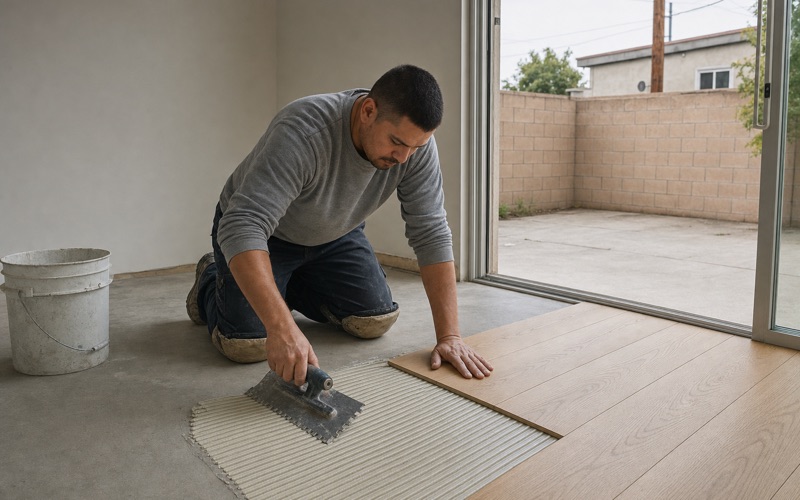
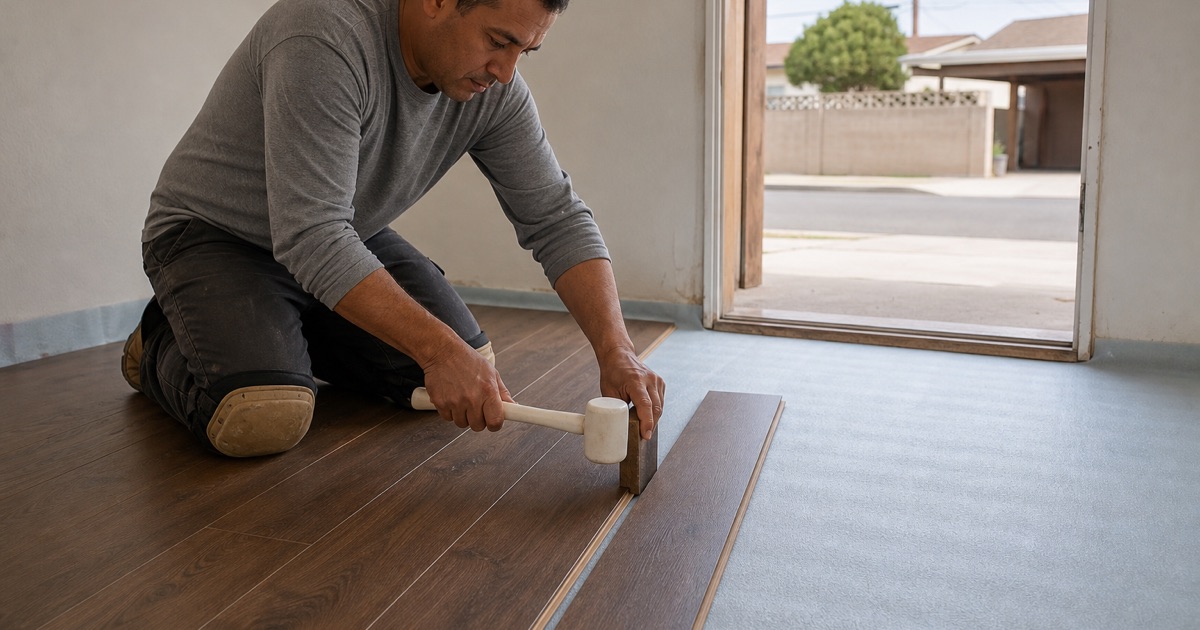
Every board is bonded directly to the prepared slab with a moisture-cure urethane adhesive, spread with a notched trowel sized to the product. The result is the most solid-feeling and quietest floor available over concrete, with no hollow report underfoot and no movement at the perimeter. It is what we recommend wherever the slab will support it, because it behaves most like a floor that was always meant to be there.
The requirement is a slab that is genuinely flat and genuinely dry. Adhesive bridges nothing — every high and low spot telegraphs into the finished surface, and every deviation becomes a place the bond is working harder than it should. Preparation is not a preliminary to a glue-down installation, it is most of the installation.
Floating
A floating floor locks board to board and rests on an underlayment without bonding to the concrete at all. It installs faster, tolerates a little more slab variation, and can be lifted later without destroying the boards, which matters in a rental or anywhere the floor might need to come up. It is a genuinely good option rather than a fallback.
The trade is acoustic and tactile. A floating floor sounds different underfoot — slightly hollower, with more report from hard-soled shoes — and the underlayment does most of the work in managing that. In a bedroom nobody notices; in an open living area with hard surfaces it is more apparent, so it is worth being deliberate about.
Letting the Slab Decide
The honest way to choose is to prepare the slab, measure it, and let the numbers pick. A slab that comes back flat and dry can take either, so preference and budget decide. A slab with more variation than a glue-down will tolerate points to floating unless you are prepared to pay for levelling. A slab reading high for moisture points to mitigation before either method is on the table.
There is one further consideration that has nothing to do with the concrete, which is how long you expect to keep the floor. A bonded floor is a permanent installation and removing it is destructive to both the boards and the slab surface. A floating floor can be lifted, and in a property that may be re-let, remodelled or sold within a few years that reversibility is worth something real. It is a reasonable basis for choosing.
Preparing Concrete Properly
Flatness Before Anything Else
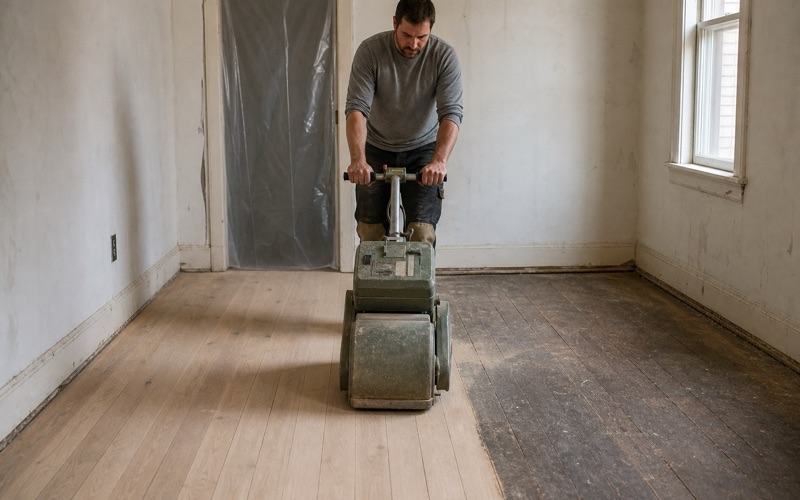
Slabs are rarely as flat as they look, and a floor is far less forgiving of deviation than carpet or tile ever was. High spots get ground down and hollows filled with a levelling compound, working to a tolerance rather than by eye. This is the least visible work in the whole job and the part that most reliably separates a floor that stays quiet from one that develops movement in its second year.
Testing for Moisture
Before any product is ordered we test the slab with an in-situ relative humidity probe, which reads conditions inside the concrete rather than at its surface. Surface tests can read reassuringly dry over a slab that is not. Wood goes down over concrete reading at or under 75 percent relative humidity, and above that a mitigation membrane comes first — a delay if you find out early, a failure if you find out late.
The reading is also the thing that protects your warranty. Manufacturers state a maximum slab condition for their products, and installing outside it generally voids the cover on material you have just paid for. Having the number written down and dated means that if anything is ever disputed, there is a record showing the floor went down into conditions it was rated for rather than an assurance that it probably did.
Underlayment and Vapor Control
What sits between concrete and wood is doing real work. A vapor retarder slows moisture migration; an underlayment adds cushioning and reduces sound transmission through the assembly. The two are sometimes one product and sometimes two, and the correct specification depends on the attachment method and on what the slab measured, which is another reason the testing comes first.
Getting the Most From an Engineered Floor
Reading the Wear Layer Specification
Ask for wear layer thickness before you ask anything else about an engineered product. It is the only part of the board that can ever be sanded, so it determines whether this is a floor with future refinishes in it or a single-life surface to be recoated and eventually replaced. Two products at the same price can differ substantially here, and the thicker one is buying you decades.
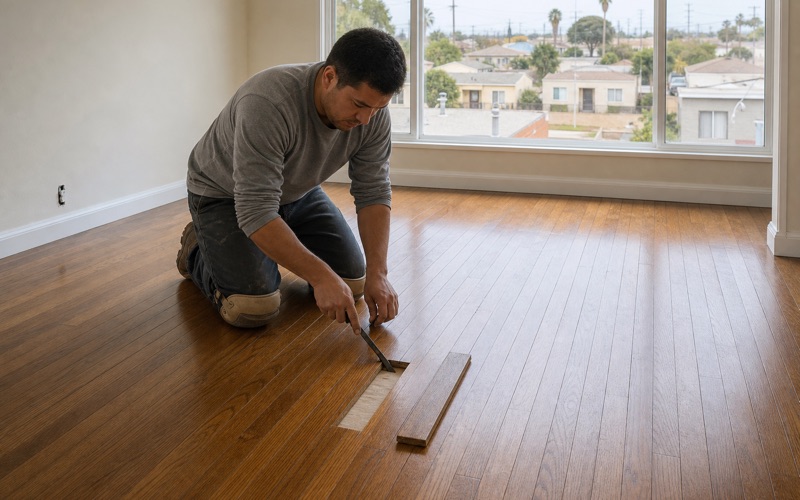
The practical translation is what a floor’s second life looks like. A generous wear layer means that in twenty years the floor can be sanded back and given any color you want, exactly like a solid floor. A thin one means that at the same point the options are a recoat or replacement. Neither is wrong, but they are very different propositions and the difference is invisible once the floor is down.
Core Construction Matters More Than It Looks
A cross-laid plywood core and a fibreboard core are not equivalent. Plywood generally holds fasteners better, tolerates a damp event more forgivingly, and is what we prefer over concrete in this climate. Fibreboard cores can be flatter and more consistent but are less tolerant of moisture reaching them. The core is invisible after installation, which is exactly why it deserves attention beforehand.
Width, Species and Finish
Everything available in solid is available here — white oak, hickory, walnut — and engineered offers wider boards than solid can safely manage on concrete, because the stable core makes width less of a risk. Prefinished product arrives cured, so there is no drying time on site. Site-finished engineered floors give a continuous surface with no bevel between boards and allow any color, at the cost of cure time in the house.
- 20+ Years in Southeast LA
- Free Written Estimates
- Licensed & Insured